It’s almost impossible to read any news about education without reading articles about the future impact of Artificial Intelligence on how we learn and how we work. If there’s a “Wicked Problem” that very few people claim to know how to solve, this is it.
Coined in 1973 by design theorists Horst Rittel and Melvin Webber, a Wicked Problem is a complex, ambiguous social or cultural issue that is almost impossible to solve because of nebulous, shifting, and increasingly murky success criteria. I previously wrote about using some of Scott Carlson’s and Ned Laff’s ideas from Hacking College to create Wicked Problem Studios that could be taught in high school. That article specifically singled out independent schools as a forum for many of the concepts, primarily because of the higher percentage of students in grades 9-12 who attend college.
I had a conversation with Ned Laff, co-author of Hacking College, who liked my idea of building a Wicked Problem Studio for independent school (and public school) students in high school. He suggested that I consider finding ways to build a localized focus on each Wicked Problem to make it more interesting to students at that age level who may not have developed a regional, national, or global perspective.
I used ChatGPT Pro to develop the graphic design for the Wicked Problem Studio overview portrayed in that article. The driving question was: “How do we prepare people to thrive in the age of artificial intelligence while protecting human creativity, judgement, and opportunity.” I directed ChatGPT Pro to organize the topics into six units with a timeline of six weeks per unit. This aligned with a 36-week academic year that most schools organize under and could be split into trimesters (two six-week units each) or two semesters (three six-week units each).
The only part of the Wicked Problem Studio included in that article was the graphic design outlining the organization into six units. After receiving feedback from several colleagues and friends including Ned, I opted to see if I could build out the rest of the studio with the assistance of ChatGPT Pro.
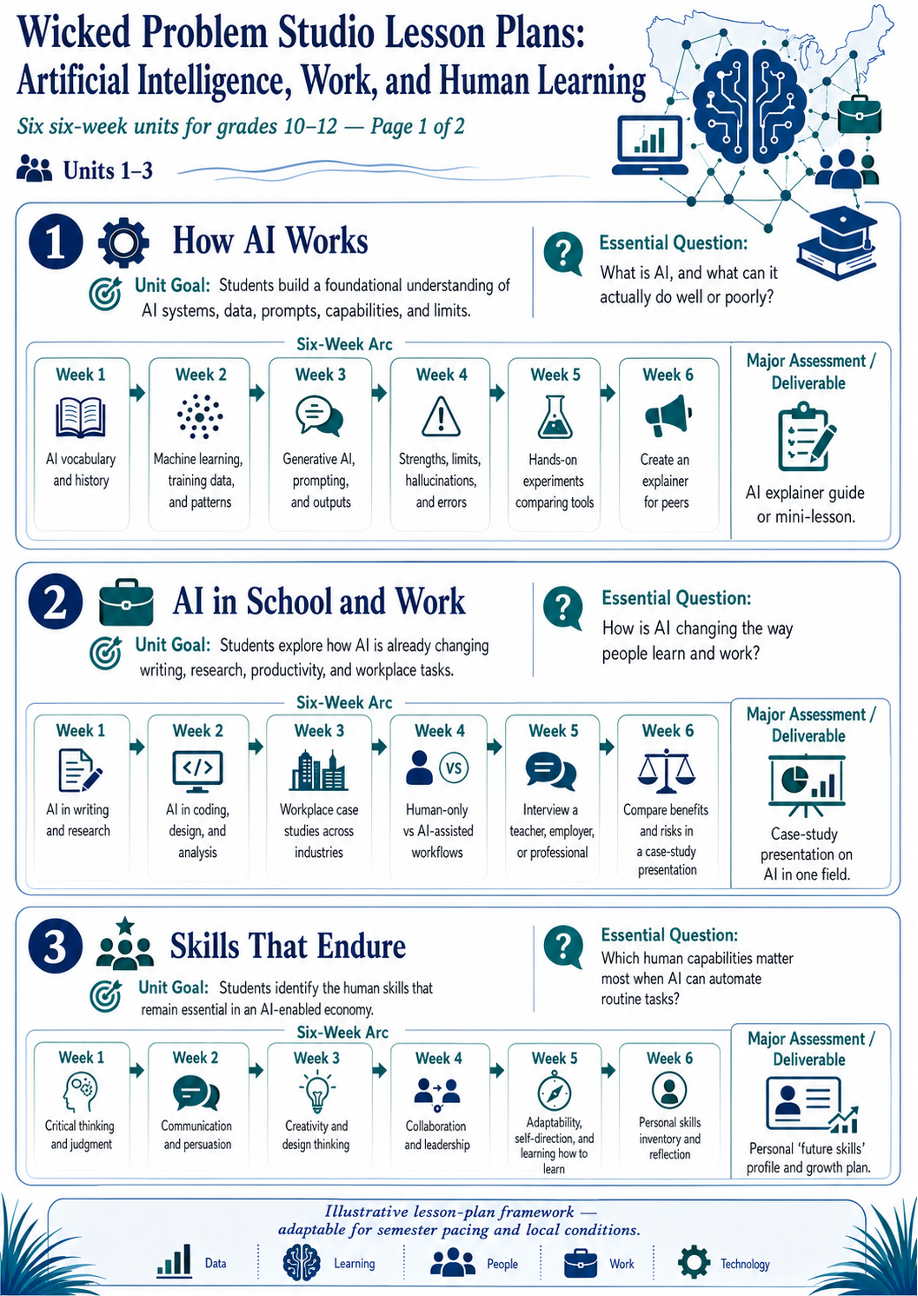
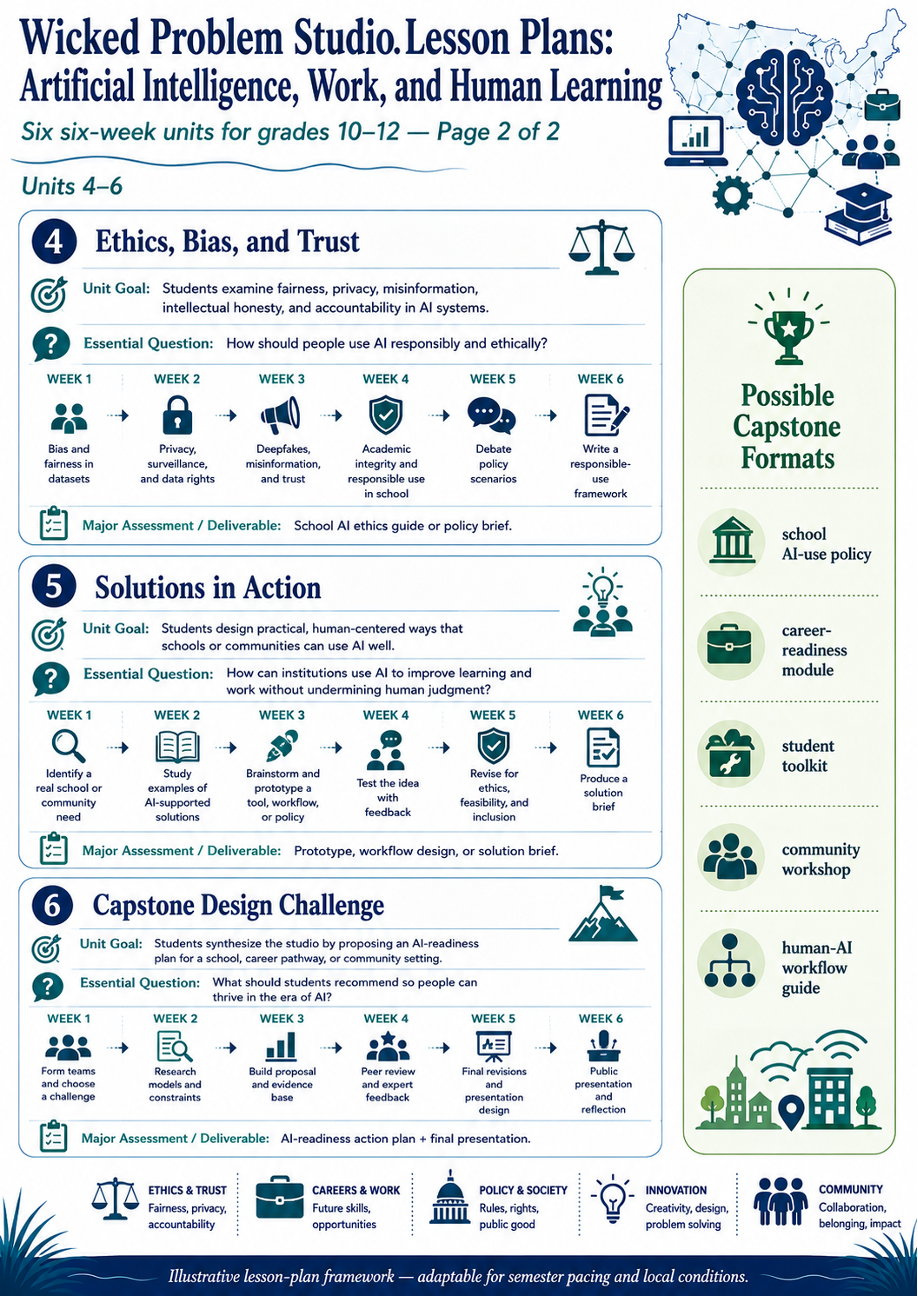
I used the six unit descriptions generated in the design and prompted ChatGPT Pro to develop specific assignments for each week of the six-week units. The units and their week-by-week assignments are listed below in sequence. I reviewed the output and chose not to edit any of it. I thought it would be helpful for readers to view the actual output from my ChatGPT Pro prompts and evaluate it before any edits were made.
For anyone interested in the concept of creating and teaching Wicked Problem Studios, I propose creating an overview similar to the two-page illustration below and sending it to a panel of interdisciplinary teachers for review to ensure it covers all the major components of the problem-solving framework. After such a review, an AI tool like ChatGPT Pro could be used to create assignments for each unit that teachers could review and edit, or teachers could create the assignments the old-fashioned way.
Since I believe that people using AI tools are collectively smarter than the AI tools themselves, I think exercises like this illustrate how teachers can leverage these tools to develop a curriculum in hours rather than weeks.
Assignment Framework Developed
Below is a specific assignment framework for the Artificial Intelligence, Work, and Human Learning Wicked Problem Studio, organized as six six-week units for grades 10–12.
Each unit assumes one major assignment per week, building toward a unit deliverable and then a final capstone. Students should maintain an AI Studio Portfolio throughout the course.
There are three standing expectations for every assignment:
- Students must keep an AI-use log documenting tools used, prompts entered, outputs received, revisions made, and human decisions added.
- Students must not enter private personal information, school records, or confidential data into AI tools.
- Students must distinguish clearly between AI-generated material, human revision, verified evidence, and original judgment.
Wicked Problem Studio Assignments
Artificial Intelligence, Work, and Human Learning
Driving Question: How do we prepare people to thrive in the age of artificial intelligence while protecting human creativity, judgment, and opportunity?
Unit 1: How AI Works
Unit focus: Students build foundational understanding of AI systems, data, prompts, outputs, strengths, and limitations.
Major unit deliverable: AI explainer guide or mini lesson.
Week 1 Assignment: AI Vocabulary Glossary
Students create an illustrated glossary of 15–20 core AI terms. Suggested terms include artificial intelligence, algorithm, machine learning, training data, model, generative AI, large language model, prompt, output, hallucination, bias, automation, chatbot, neural network, and human-in-the-loop.
Student product: A digital or print glossary with student-friendly definitions, one example per term, and an icon or visual metaphor.
Assessment focus: Accuracy, clarity, use of examples, and ability to explain technical ideas in accessible language.
Week 2 Assignment: Data Pattern Memo
Students examine a simple dataset, such as movie preferences, school lunch choices, weather records, or mock hiring data. They identify patterns in the data and explain what a machine might “learn” from those patterns.
Student product: A one-page memo titled “What This Dataset Teaches.”
Assessment focus: Pattern recognition, understanding of training data, recognition of limitations, and explanation of possible bias.
Week 3 Assignment: Prompting Lab
Students ask an AI tool the same question using three different prompts: a vague prompt, a specific prompt, and a role- or audience-based prompt. They compare the outputs.
Student product: A prompt comparison chart with the original prompts, summaries of outputs, and a reflection on what changed.
Assessment focus: Prompt design, comparison, clarity of analysis, and understanding that AI output depends heavily on user instructions.
Week 4 Assignment: Hallucination Hunt
Students generate or examine AI responses on a teacher-approved topic, then fact-check the responses using reliable sources. They annotate errors, unsupported claims, omissions, or misleading language.
Student product: An annotated AI response with at least five comments and a short reliability rating.
Assessment focus: Factchecking, source evaluation, skepticism, and evidence-based critique.
Week 5 Assignment: Tool Comparison Lab
Students compare two AI tools or two AI-assisted workflows on the same task, such as summarizing an article, creating a study guide, generating research questions, or organizing notes.
Student product: A comparison matrix rating accuracy, usefulness, bias risk, transparency, ease of use, and need for human revision.
Assessment focus: Comparative evaluation, responsible tool use, and judgment about appropriate use cases.
Week 6 Assignment: Peer Teach-Back
Students design and deliver a five-minute mini-lesson explaining one AI concept to classmates.
Student product: A short slide deck, handout, visual explainer, or live demonstration.
Assessment focus: Conceptual understanding, communication, accuracy, and ability to teach peers.
Unit 1 culminating assessment:
Students compile their glossary, prompt lab, hallucination hunt, and tool comparison into an AI Explainer Guide for students or families.
Unit 2: AI in School and Work
Unit focus: Students investigate how AI is changing learning, writing, research, productivity, and workplace tasks.
Major unit deliverable: Case-study presentation on AI in one field.
Week 1 Assignment: Writing Comparison
Students complete a short writing task twice: once without AI assistance and once with AI assistance. The topic should be low-stakes and teacher-approved. They compare the two processes and outcomes.
Student product: A reflection titled “What AI Changed and What It Did Not Change.”
Assessment focus: Metacognition, writing process, ethical disclosure, and quality of reflection.
Week 2 Assignment: Workflow Demonstration
Students choose one workflow where AI might assist: brainstorming, coding, editing, data analysis, design, scheduling, or note-taking. They document the workflow step by step.
Student product: A workflow diagram showing where AI helps, where humans remain necessary, and where risks appear.
Assessment focus: Process mapping, practical understanding, and recognition of human oversight.
Week 3 Assignment: Industry Case Study
Students select one field—healthcare, law, education, journalism, finance, engineering, marketing, agriculture, entertainment, government, or nonprofit work—and research how AI is affecting it.
Student product: A short case-study slide deck.
Required slides should include:
field overview; current AI uses; benefits; risks; jobs or tasks affected; skills workers will need; one unresolved question.
Assessment focus: Research quality, field-specific understanding, and balanced analysis.
Week 4 Assignment: Time and Quality Study
Students compare a human-only workflow with an AI-assisted workflow. They track time, quality, ease, frustration, and revision needs.
Student product: A brief report with a chart or table comparing the two approaches.
Assessment focus: Evidence-based comparison, honest reflection, and ability to avoid simplistic “AI is better” or “AI is worse” conclusions.
Week 5 Assignment: Expert Interview
Students interview a teacher, employer, professional, college faculty member, or technology leader about AI use in school or work.
Student product: Interview notes plus a one-page synthesis.
Suggested interview questions:
How is AI changing your work?
What tasks does it help with?
What risks concern you?
What skills will young people need?
What should schools teach about AI?
Assessment focus: Quality of questions, professionalism, synthesis, and connection to course themes.
Week 6 Assignment: Case-Study Presentation
Students present their industry case study to classmates.
Student product: A 5–7-minute presentation with visuals and a short audience Q&A.
Assessment focus: Evidence, organization, clarity, field-specific insight, and balanced discussion of benefits and risks.
Unit 2 culminating assessment:
Students submit a revised AI in One Field Case Study, including research, interview evidence, workflow analysis, and recommendations for students interested in that field.
Unit 3: Skills That Endure
Unit focus: Students identify, practice, and document the human capabilities that remain essential in an AI-enabled economy.
Major unit deliverable: Personal future-skills portfolio and growth plan.
Week 1 Assignment: Judgment Memo
Students analyze a scenario in which AI gives a recommendation, but the human decision is not obvious. Examples might involve hiring, medical triage, school discipline, college advising, financial aid, or news moderation.
Student product: A one-page decision memo answering: What does the AI recommend? What information is missing? What human values matter? What decision would you make and why?
Assessment focus: Ethical reasoning, judgment, clarity, and attention to context.
Week 2 Assignment: Persuasion Task
Students create a short speech, editorial, video script, or public message persuading a specific audience about an AI-related issue.
Possible topics:
Students should disclose AI use.
Schools should teach prompt literacy.
AI should not replace human feedback.
Workers need lifelong learning opportunities.
AI tools should be audited for bias.
Student product: A persuasive communication piece.
Assessment focus: Audience awareness, argument, evidence, tone, and communication skill.
Week 3 Assignment: Creativity Challenge
Students redesign a product, service, classroom routine, school process, or community experience using design thinking. AI may be used for brainstorming, but students must make the final design decisions.
Student product: A prototype sketch, storyboard, concept map, or design brief.
Assessment focus: Creativity, problem definition, iteration, and explanation of human choices.
Week 4 Assignment: Teamwork Simulation
Students complete a collaborative challenge, such as designing an AI-use policy for a classroom, planning a community workshop, or evaluating a fictional AI product.
Student product: Team output plus individual collaboration retrospective.
Reflection questions:
What role did I play?
Where did our team communicate well?
Where did we struggle?
How did we resolve disagreement?
What would I do differently next time?
Assessment focus: Collaboration, leadership, accountability, and reflective honesty.
Week 5 Assignment: Adaptability Plan
Students research how one career or field is changing because of AI and identify what a person in that field would need to keep learning.
Student product: A personal learning plan with three skills to build, three resources to use, and three habits to develop.
Assessment focus: Career awareness, adaptability, realistic planning, and self-direction.
Week 6 Assignment: Future Skills Profile
Students create a personal profile of their current strengths and growth areas in relation to the AI era.
Suggested categories:
critical thinking; communication; creativity; collaboration; ethical judgment; technical fluency; adaptability; initiative.
Student product: A future-skills portfolio and growth plan.
Assessment focus: Self-knowledge, specificity, evidence from prior assignments, and realistic next steps.
Unit 3 culminating assessment:
Students submit a Personal Future-Skills Portfolio connecting their work from the unit to college, career, and civic readiness.
Unit 4: Ethics, Bias, and Trust
Unit focus: Students examine fairness, privacy, misinformation, intellectual honesty, and accountability in AI systems.
Major unit deliverable: School AI ethics guide or policy brief.
Week 1 Assignment: Bias Audit
Students examine a dataset, AI-generated output, recommendation system, or fictional algorithmic decision for possible bias.
Student product: A bias audit worksheet identifying who benefits, who may be harmed, what data may be missing, and what safeguards are needed.
Assessment focus: Fairness, evidence, perspective-taking, and ability to detect hidden assumptions.
Week 2 Assignment: Privacy Case Brief
Students analyze a case involving student data, facial recognition, online tracking, surveillance, health data, or workplace monitoring.
Student product: A two-page case brief.
Required sections:
case summary; stakeholders; privacy risks; benefits claimed; ethical concerns; recommended guardrails.
Assessment focus: Ethical analysis, privacy reasoning, and policy awareness.
Week 3 Assignment: Deepfake and Misinformation Analysis
Students examine examples of synthetic media, manipulated images, fake audio, AI-generated text, or misinformation campaigns.
Student product: An annotated example plus a short guide titled “How to Evaluate Whether This Is Trustworthy.”
Assessment focus: Media literacy, verification strategies, and understanding of trust breakdown.
Week 4 Assignment: Academic Integrity Policy Draft
Students draft guidelines for responsible AI use in schoolwork.
The draft should address:
when AI use is allowed; when it is not allowed; how students should disclose AI use; what counts as meaningful human contribution; how teachers should evaluate work.
Student product: A one-page student-facing AI-use policy.
Assessment focus: Practicality, clarity, fairness, and alignment with learning goals.
Week 5 Assignment: Structured Debate
Students participate in a formal debate on an AI ethics or policy question.
Possible motions:
Schools should allow AI for brainstorming but not drafting.
Employers should disclose when AI screens job applicants.
AI-generated political content should be labeled.
Students should be graded partly on how they use AI responsibly.
Student product: Debate preparation notes and post-debate reflection.
Assessment focus: Evidence, reasoning, listening, rebuttal, and respectful disagreement.
Week 6 Assignment: Responsible-Use Framework
Students synthesize the unit into a responsible-use framework for a school, club, classroom, or community organization.
Student product: A policy brief or ethics guide.
Required sections:
purpose; acceptable uses; unacceptable uses; disclosure expectations; privacy protections; bias safeguards; human oversight; review process.
Assessment focus: Ethical reasoning, policy design, clarity, and feasibility.
Unit 4 culminating assessment:
Students submit a School AI Ethics Guide or Policy Brief that could be reviewed by school leaders.
Unit 5: Solutions in Action
Unit focus: Students design practical, human-centered ways schools or communities can use AI well.
Major unit deliverable: Prototype, workflow design, or solution brief.
Week 1 Assignment: Needs Assessment
Students identify a real school or community need where AI might help, but only if used carefully.
Possible needs:
student study support; college counseling preparation; language learning; tutoring; accessibility; teacher workload; community information; career exploration; library research support.
Student product: A needs-assessment memo.
Required sections:
problem; affected users; current pain points; why AI might help; why AI might not help; risks to avoid.
Assessment focus: Problem definition, user awareness, and realistic thinking.
Week 2 Assignment: Solution Scan
Students research three existing AI-supported tools, workflows, policies, or programs related to their chosen need.
Student product: A solution scan chart.
Required columns:
solution; target users; benefits; limitations; equity concerns; privacy concerns; evidence of usefulness; adaptation ideas.
Assessment focus: Research, comparison, and ability to learn from existing models.
Week 3 Assignment: Prototype Sprint
Students brainstorm and prototype a tool, workflow, policy, training module, or guide.
Examples:
student AI-use checklist; teacher feedback workflow; career exploration chatbot protocol; responsible prompting guide; AI-supported study routine; parent information guide; school club AI policy.
Student product: Low-fidelity prototype, workflow map, storyboard, or draft guide.
Assessment focus: Design thinking, creativity, connection to user needs, and feasibility.
Week 4 Assignment: User Feedback Test
Students test their idea with classmates, teachers, staff, parents, or community members.
Student product: Feedback summary with at least five user comments or observations.
Required reflection:
What did users understand?
What confused them?
What did they value?
What risks did they notice?
What should change?
Assessment focus: Feedback collection, humility, listening, and revision planning.
Week 5 Assignment: Revision Memo
Students revise their solution based on feedback and evaluate it through ethical, practical, and equity lenses.
Student product: Revision memo.
Required sections:
what changed; why it changed; privacy safeguards; bias safeguards; accessibility considerations; implementation challenges.
Assessment focus: Iteration, ethical design, feasibility, and inclusion.
Week 6 Assignment: Solution Brief
Students produce a final solution brief explaining their proposed AI-supported intervention.
Student product: Three- to five-page solution brief or equivalent presentation document.
Required sections:
problem; users; proposed solution; implementation plan; risks; safeguards; evidence; next steps.
Assessment focus: Coherence, practicality, ethical safeguards, and communication.
Unit 5 culminating assessment:
Students submit a Prototype and Solution Brief suitable for presentation to a school or community audience.
Unit 6: Capstone Design Challenge
Unit focus: Students synthesize the studio by proposing an AI-readiness plan, tool, or policy for a real audience.
Major unit deliverable: AI-readiness action plan and final presentation.
Week 1 Assignment: Challenge Proposal
Student teams select a final challenge connected to AI, work, learning, ethics, or community readiness.
Possible capstone topics:
school AI-use policy; AI and college readiness; AI and academic integrity; AI and career exploration; AI and student mental workload; AI and media literacy; AI and future skills; AI and teacher support; AI and equitable access.
Student product: One-page challenge proposal.
Required sections:
driving question; target audience; problem statement; why it matters; proposed product; early research questions.
Assessment focus: Focus, relevance, audience, and feasibility.
Week 2 Assignment: Research Matrix
Teams research models, examples, policies, expert views, and constraints related to their challenge.
Student product: Research matrix with at least eight sources or examples.
Suggested columns:
source or model; key idea; evidence; relevance; limitation; how it informs our project.
Assessment focus: Research depth, source quality, synthesis, and connection to project design.
Week 3 Assignment: Draft Action Plan
Teams create a first full draft of their capstone product.
Possible products:
policy proposal; training module; student toolkit; parent guide; teacher workflow; career-readiness resource; community workshop plan; human-AI collaboration guide.
Student product: Draft action plan or prototype.
Required sections:
audience; goals; proposed actions; timeline; needed resources; risks; safeguards; success measures.
Assessment focus: Structure, feasibility, audience alignment, and evidence base.
Week 4 Assignment: Feedback Round
Teams present their draft to peers and at least one outside reviewer, such as a teacher, administrator, counselor, librarian, employer, alumnus, or technology professional.
Student product: Feedback synthesis.
Required sections:
who reviewed it; what feedback they gave; what patterns emerged; what the team will revise; what the team will not revise and why.
Assessment focus: Responsiveness, professionalism, stakeholder engagement, and revision judgment.
Week 5 Assignment: Final Revision and Presentation Design
Teams revise their written proposal and prepare a final presentation.
Student product: Final written proposal plus presentation deck, poster, demonstration, workshop plan, or policy document.
Required elements:
clear problem statement; evidence; proposed solution; implementation steps; ethical safeguards; cost or resource considerations; success indicators.
Assessment focus: Quality of revision, clarity, persuasiveness, design, and readiness for public presentation.
Week 6 Assignment: Public Presentation and Reflection
Teams deliver their capstone to an authentic audience.
Possible audiences:
school leadership team; faculty committee; technology committee; parent association; student government; local employers; alumni panel; board committee; community organization.
Student product: Public presentation plus individual reflection.
Individual reflection questions:
What did I contribute?
What did I learn about AI?
What did I learn about human judgment?
What would I revise if this project continued?
How has my thinking about college, work, and learning changed?
Assessment focus: Presentation quality, evidence, feasibility, ethical reasoning, teamwork, and personal reflection.
Unit 6 culminating assessment:
Students submit and present an AI-Readiness Action Plan for a real school, career, or community context.
Suggested Portfolio Structure
By the end of the studio, each student’s AI Studio Portfolio could include:
- AI vocabulary glossary
- Prompting lab and hallucination hunt
- Tool comparison matrix
- AI in one field case study
- Expert interview synthesis
- Future-skills profile
- Bias audit
- Privacy or misinformation case brief
- Responsible-use framework
- Solution brief or prototype
- Capstone proposal and presentation
- Final personal reflection
Simple Assessment Categories Across the Studio
A common rubric could evaluate students on:
Conceptual understanding: Does the student understand how AI works and where its limits are?
Evidence and verification: Does the student check claims, use reliable sources, and avoid unsupported conclusions?
Ethical reasoning: Does the student consider fairness, privacy, bias, transparency, and human responsibility?
Human skill development: Does the student demonstrate judgment, communication, creativity, collaboration, and adaptability?
Practical design: Are the proposed solutions realistic, useful, and appropriate for the intended audience?
Reflection: Can the student explain how their thinking changed and what they still need to learn?
The overall purpose is to help students leave the studio not merely knowing about AI, but knowing how to work with it, question it, govern it, and preserve the human capabilities that matter most.
Final Thoughts
Since ChatGPT was first made available to the masses in November 2022, I have utilized output from ChatGPT and other AI tools in numerous articles in my blog. I have provided transparency in the form of disclosure regarding the AI tool and the extent to which I used it for my published content.
It was easy to identify AI-generated content in the earlier versions of LLMs. It’s getting harder as the LLMs gain sophistication and minimize their hallucinations. At some point, many professionals will be expected to use these tools as part of their routine work.
It took me less than five minutes to generate the graphics for this course and approximately the same time for the list of assignments in each of the six six-week units. Are the assignments perfect? No. What would I do to make them perfect? I’d sit down with a group of colleagues (assuming I’m a teacher at a high school committed to this Wicked Problem Studio idea) and discuss each of the units and the specific assignments, tweaking them along the way.
ChatGPT and other AI tools are designed for rapid iteration. They don’t get tired or frustrated (yet). I am sure that people are using these tools to design courses, both in person and online. Some may choose to disclose their use of the AI tools, and some may not.
This is another example of a situation where knowledge is transitioning from a scarce resource to a commodity. The only difference may be in the effectiveness of the teacher/instructor who teaches it. There are many downstream repercussions for courses that can be constructed, designed, and implemented by people who may not have the prerequisite knowledge of the subject matter experts who teach those courses now. One of the biggest downstream impacts may be that educational institutions will only be able to charge tuition based on the value of their community and not the content of their courses. And that idea could be the basis for a future article.