The first wave of generative AI changed how people write, search, summarize, code, and brainstorm. Since the first version of ChatGPT was opened to the public, I’ve written frequently about LLMs, their capabilities, and their impact on education and the workforce. The next wave of generative AI will change how work itself is organized. That wave will make a huge impact on our workforce.
A chatbot is a powerful assistant that usually waits for a person to ask a question, copy information from one system, paste it into another, and decide what to do next. Agentic AI changes the model by combining generative AI with memory, planning, tools, and access to enterprise systems. The Boston Consulting Group (BCG) describes AI agents as systems that can observe their environment, plan with language models, and act in a continuous cycle through connected tools and data sources to accomplish goals (see BCG illustration below).
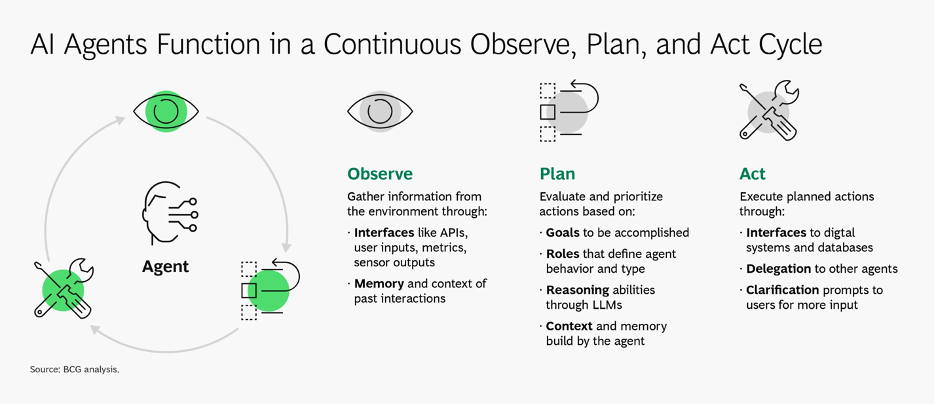
The workforce impact of AI over the next 36 months is likely to be driven less by “better prompts” and more by new human-agent workflows. In BCG’s shorthand, an agent is an AI that uses tools to accomplish goals. An AI agent observes, plans, and acts, often by drawing on memory and external systems. When AI agents are embedded in customer service platforms, learning management systems, HR systems, CRMs, ERPs, research databases, software repositories, and analytics platforms, the human role changes. People stop being the connective tissue between systems. They become designers, supervisors, validators, exception handlers, and accountable decision makers.
This distinction helps explain the claim that AI tools may become “ten times more powerful” within three years. That phrase is likely too broad to treat as a literal forecast for every job, but it is directionally plausible for agentic capability in some workflows. BCG’s February 2026 HR Executive Perspective noted that AI agents now reliably complete one-hour tasks, that the length of automatable tasks continues to double every seven months, and that token costs for frontier-level performance have dropped roughly tenfold. METR, a research organization that measures AI task-completion capabilities, similarly found that the length of tasks frontier AI agents can complete with 50% reliability has doubled about every 7 months over the past 6 years (see illustration from the METR report appended below).
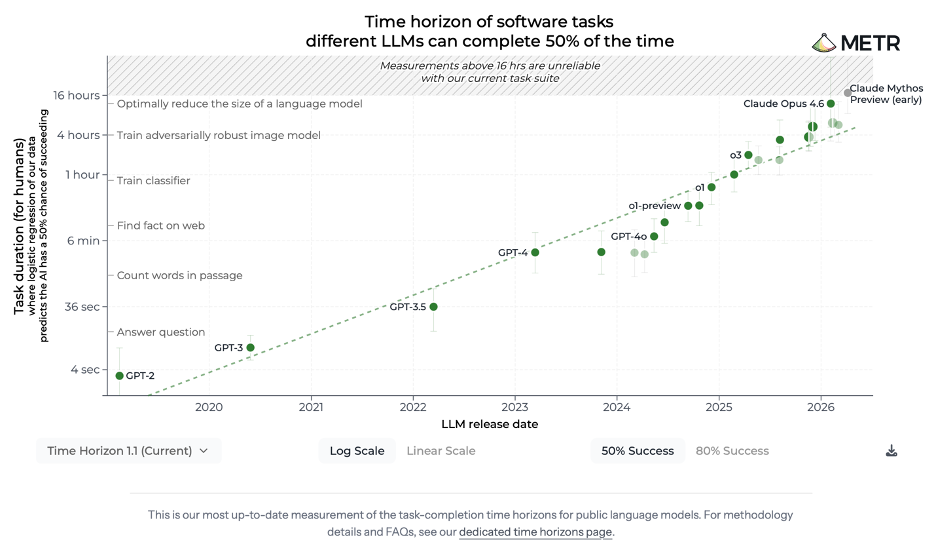
If that seven-month doubling trend continued for 36 months, it would imply roughly 5 doublings; more than a 30-fold increase in the length of tasks agents can attempt with similar reliability. That does not mean every employee will become 30 times more productive. The real world has messy data, regulations, politics, customers, legacy systems, and trust constraints. But it does mean that the “unit of work” AI can handle is expanding rapidly. The question for employers is not simply, “Can AI do this task?” It is, “How will a job change when AI can handle a longer chain of tasks across systems?”
BCG’s Deploy, Reshape, Invent framework, outlined in 2023, is useful. In the Deploy phase, organizations give workers AI tools inside their everyday software. BCG has estimated that this can produce broad productivity gains of 10% to 20%. In the Reshape phase, organizations redesign processes and functions around AI, with potential efficiency and effectiveness gains of 30% to 50%. In the Invent phase, companies create new customer experiences, services, offerings, and business models. The biggest workforce effects will come from the second and third phases. Deploying a chatbot saves time. Reshaping a workflow changes jobs. Inventing new offerings changes the demand for skills.
How Will This Really Change Work?
The future of work depends on two questions: First, does AI substitute for human work or augment it? Second, when AI lowers the cost or time required to produce an output, does demand expand? Those two questions yield very different labor-market outcomes, as outlined in an April 2026 BCG whitepaper. Exhibit 1 from that paper is appended below.
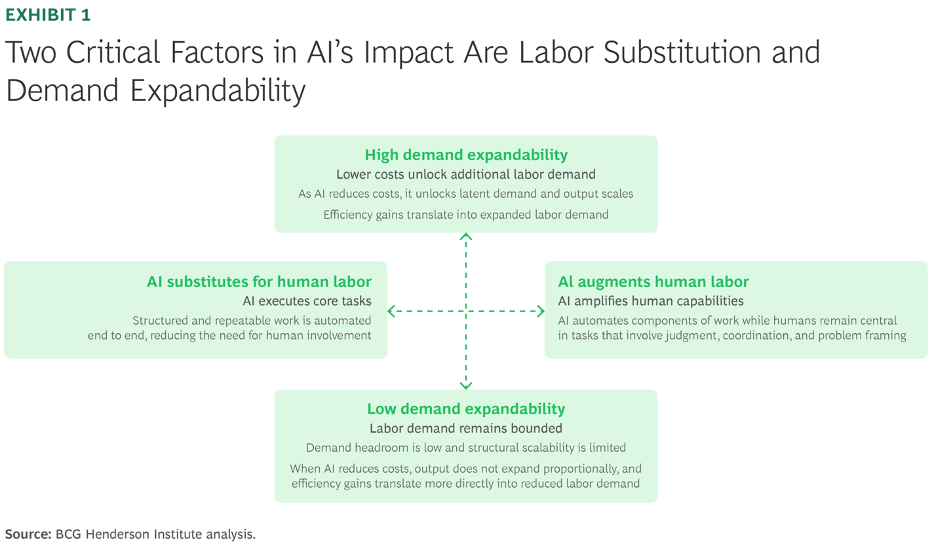
In substituted roles, AI can replace a meaningful share of human activity, and demand is not very expandable. Think of routine, bounded work where the volume of demand does not grow simply because the work becomes cheaper. In these cases, agentic AI is more likely to reduce headcount or slow hiring. Call center representatives are cited by BCG as a role likely to experience major headcount reduction.
In divergent roles, AI substitutes for some human tasks, but demand can expand. This is a more complicated category. Some work disappears, especially routine entry-level work, but new demand may create higher-level jobs. The organization may produce much more output with fewer people in old roles, while creating new roles in orchestration, oversight, customer success, compliance, implementation, and product design.
In rebalanced roles, AI augments human workers, but demand is relatively bounded. Headcount may remain stable, but the job changes. Routine work shrinks. Judgment, communication, synthesis, and accountability become more central. Workers are expected to do more with AI, not simply do the old job faster.
In amplified roles, AI augments human workers, and demand expands. These are the roles where productivity gains can translate into more work, more output, and potentially more jobs. BCG places software engineering in this general category today because AI can accelerate code generation and testing, but humans still own system design, architecture, security, tradeoffs, integration, and accountability.
This is why the next 36 months should not be framed as a simple story of “AI will take jobs” or “AI will create jobs.” BCG’s recent workforce analysis estimates that 43% of U.S. jobs exceed a 40% task-automation threshold, making them more likely to face material disruption. Yet BCG also argues that 50% to 55% of U.S. jobs will be reshaped over the next two to three years, while 10% to 15% may be vulnerable to elimination over a longer four- to five-year window. The center of gravity is not immediate mass unemployment. It is rapid role redesign.
The most urgent consequence may be the compression of entry-level work. Many junior roles have historically been built around routine execution: drafting first versions, cleaning data, preparing reports, checking documents, answering standard questions, writing basic code, scheduling, summarizing, and moving information across systems. Agentic AI is especially suited to these tasks because they are structured, repeatable, and increasingly connected to digital systems. BCG warns that as AI absorbs much of the routine work that justified large entry-level hiring cohorts, fewer execution-focused entry-level roles may be required in the short term. The roles that remain will ask junior employees to supervise AI outputs, manage exceptions, and contribute to more complex problem-solving earlier in their careers.
Education Needs to Be Prepared
That shift should command the attention of colleges. Higher education has long prepared students for the first rung of professional work. But if AI removes or compresses that first rung, colleges cannot simply add an AI literacy module and move on. They need to redesign the bridge between education and employment. Students will need practice working with agents, evaluating AI output, designing workflows, asking better questions, interpreting data, and exercising judgment in ambiguous situations.
The skills premium is already moving in that direction. The World Economic Forum’s Future of Jobs Report 2025 found that employers expect 39% of key job skills to change by 2030, with AI, big data, technological literacy, creative thinking, resilience, flexibility, curiosity, lifelong learning, leadership, and analytical thinking among the skills expected to rise in importance. PwC’s 2026 Global AI Jobs Barometer similarly found that skills in the most AI-exposed jobs are changing more than twice as fast as those in the least-exposed roles, and that AI-exposed junior roles are seven times more likely to demand traditionally senior skills such as leadership.
This creates a new mandate for colleges; namely, that students should be taught to work at a higher level sooner. That does not mean every student must become a machine learning engineer. It means every student should understand how AI agents interact with data, tools, and systems in their field. A business student should learn how agents change sales, finance, operations, and customer service workflows. A computer science student should learn not only to code, but to orchestrate code-generating agents, test their outputs, and manage software quality. A health professions student should learn where AI can reduce documentation burden and where human judgment remains essential. An education student should learn how AI changes lesson planning, assessment, tutoring, accessibility, and academic integrity.
Colleges also need to treat their own operations as laboratories for responsible agentic AI. An EDUCAUSE survey in the Fall of 2025 found that 94% of higher education respondents had used AI tools for work in the previous six months, but only 54% were aware of policies or guidelines for that use. The EDUCAUSE survey also found that 56% of respondents had used tools not provided by their institutions, creating risks around privacy, cybersecurity, accessibility, accuracy, copyright, and intellectual property. In other words, colleges are already living through the same workforce transition they are trying to prepare students for.
The best institutional response is not prohibition. It is disciplined experimentation. Colleges should map the work of faculty, staff, and students through the same lens employers are beginning to use: Which tasks are toil? Which tasks are developmental? Which tasks require human trust, judgment, and relationship? Which tasks can agents safely perform? Which tasks should agents draft but humans approve? Which tasks should remain human because the work itself builds essential capability?
This is where BCG’s theory of action—Deploy, Reshape, Invent—becomes powerful for higher education. Colleges can deploy AI tools to reduce administrative toil. They can reshape functions such as advising, enrollment, student support, finance, institutional research, and career services. And they can invent new offerings such as AI-enabled certificates, agentic workflow labs, human-AI teaming courses, employer-integrated apprenticeships, and lifelong learning programs for alumni whose jobs are being redesigned in real time.
Redesigned Doesn’t Mean Bad
The central promise is not replacing people. It is increasing human scale. Agentic AI can reduce human toil, improve productivity, increase work quality, and allow people to operate across a larger surface area of data and systems. But those benefits are not automatic. The Harvard Business School and BCG “jagged frontier” study showed that AI improved performance on tasks within its capability frontier, with knowledge worker participants (758 BCG consultants) completing more tasks faster and at higher quality, but it also worsened performance on a task outside the frontier when users over-relied on the tool. The lesson is that AI fluency is not blind trust. AI fluency is knowing when to delegate, when to verify, when to intervene, and when to keep the work human.
Over the next 36 months, the most successful workers will be the people who can redesign work around AI while preserving judgment, accountability, creativity, and trust. The most successful employers will not simply cut labor costs. They will use agentic AI to expand what their people can do. And the most successful colleges will not ask whether AI belongs in the classroom or workplace. They will ask a harder question, specifically “What must humans learn when machines can increasingly act?”
That is the workforce challenge ahead. Agentic AI will not affect every role in the same way, and it will not produce one simple labor-market story. Some jobs will be substituted. Some will diverge. Some will be rebalanced. Some will be amplified. But across all four outcomes, the direction is the same. Work is moving from task execution toward judgment-rich orchestration. Colleges and employers that prepare for that shift now will be better positioned for the next 36 months than those waiting for the future to arrive fully formed.