Independent schools have long taken pride in preparing students for college. Traditionally, that meant building a rigorous academic program, offering advanced coursework, supporting strong writing and quantitative skills, guiding students through the college admissions process, and celebrating the college list each spring. Private school graduates attend a four-year college within 12 months of graduating from high school at a rate nearly 50% higher than public school graduates.
But the world today’s high school graduates enter has changed. College itself is changing. Some students may arrive on campus with AP credits, dual enrollment credits, online learning experiences, internships, research projects, professional and industry certifications, entrepreneurial ventures, and clearer expectations about the value of higher education. At the same time, other students still struggle to understand how college works once they get there. They may know how to get admitted, but not how to use the institution well.
This is a discrepancy that needs attention.
A student can enter college with 18 credits (AP and dual enrollment) and still not know how those credits apply. A student can have a declared major and still not understand how to build relationships with faculty, pursue internships, explore careers, or connect academic choices to long-term goals. A student can attend a prestigious college and still move through the curriculum passively, choosing courses because they fit a schedule rather than contributing to a larger intellectual and professional direction.
This is where Scott Carlson and Ned Laff’s Hacking College: Why the Major Doesn’t Matter offers a useful framework for independent schools. Although the book is written for college students, many of its most important ideas belong in grades 9–12. If independent schools want to prepare students not just for admission to college, but for genuine college and career success, they should begin teaching students how to design their education before they leave high school.
We don’t need to turn high school into college, but we can help students arrive at college as active, informed, curious designers of their own learning.
Beyond “What Do You Want to Major In?”
High school students are often asked premature questions: What do you want to major in? What career do you want? What college do you want to attend?
These questions are not useless, but they can narrow student thinking too early. Many students do not yet know enough about themselves, the world of work, or the structure of higher education to answer them well. Worse, they may come to believe that choosing the “right” major is the key to future success.
One of the most useful ideas in Hacking College is that students should focus less on the major itself and more on building a broader “Field of Study.” A Field of Study is not simply a department label. It is a student’s evolving map of interests, questions, skills, experiences, relationships, and opportunities.
For a high school student, this shift is powerful. Instead of asking, “Do I want to major in biology, business, engineering, or political science?” the student might ask, “What kinds of problems do I want to understand?” or “What subjects do I return to even when no one assigns them?” or “What kinds of people are doing work that fascinates me?”
A student interested in climate change, for example, may discover connections among environmental science, economics, public policy, engineering, architecture, data science, ethics, and community organizing. A student interested in health may discover connections among biology, psychology, public health, technology, inequality, communication, and design. A student interested in storytelling may discover pathways through literature, film, journalism, marketing, history, digital media, and entrepreneurship.
It’s time for majors to evolve. Instead of putting hard lines around learning, students should be encouraged to view majors as one part of a larger educational design.
Teaching Students to Use the “Blank Spaces”
Another valuable concept from Hacking College is the idea of “blank spaces.” In college, these are the electives, general education courses, minors, internships, independent studies, and co-curricular opportunities that students often fill casually. They choose a course because it is convenient, because a friend recommended it, because it seems easy, or because it checks a requirement.
High school has blank spaces, too.
High school blank spaces include electives, summer programs, service projects, internships, clubs, independent studies, capstones, arts commitments, athletic leadership, online courses, dual enrollment options, and research opportunities. In many schools, students choose these experiences without much intentionality. They may accumulate impressive activities without developing a coherent sense of what they are learning or why it matters.
Independent schools can change that.
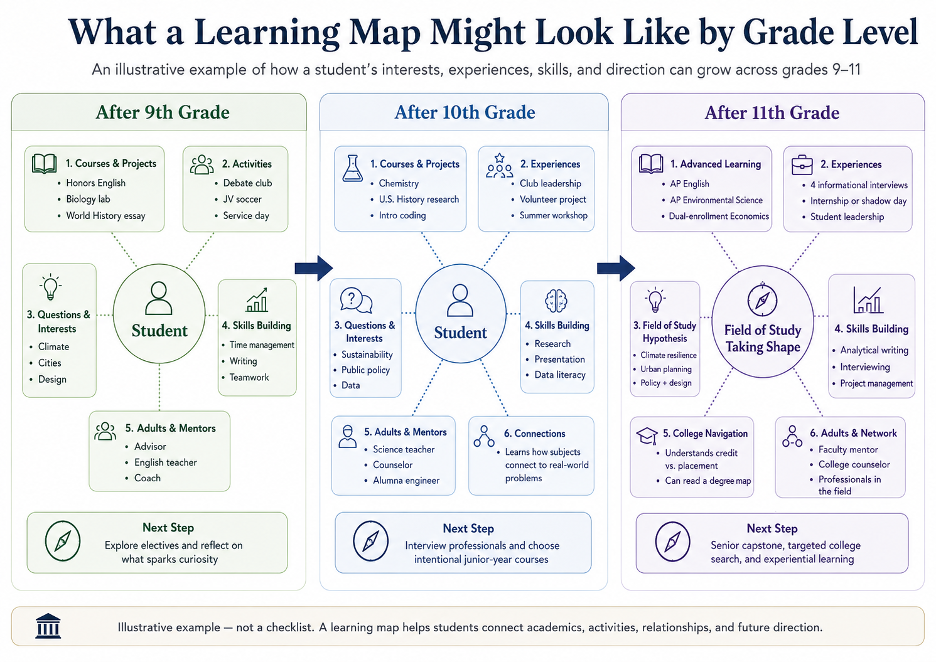
Beginning in grade 9, students could maintain a simple “Learning Map” that tracks courses, major projects, extracurricular commitments, summer experiences, service, interviews, and emerging interests. The purpose would be to help students notice patterns.
- Where have I done my best thinking?
- Which assignments stayed with me?
- What kinds of problems do I like solving?
- What skills am I building?
- What do I want to test next?
By junior year, students should be able to explain not only what they have done, but what they are learning about themselves through what they have done.
I created an example of a Learning Map using ChatGPT Pro and appended it below. I can envision how completing this with actual courses and projects would comprise a portfolio of learning, academically and experientially.
The Research Investigative Inquiry: A High School Essential
Perhaps the most practical idea independent schools can borrow from Hacking College is the Research Investigative Inquiry. In the college context, students are encouraged to research fields of interest, identify people doing meaningful work, conduct conversations, and use those insights to shape their educational choices.
This belongs in high school.
Imagine if every student completed a Research Investigative Inquiry by the end of junior year. Each student would identify a broad question, field, profession, or social problem of interest. The student would then research people and organizations connected to that area, conduct several informational interviews, synthesize what they learned, and identify the academic disciplines and experiences that could help them explore further.
This would teach several lessons at once.
Students would learn how to ask better questions. They would learn how adults’ careers develop, which is often in nonlinear and unexpected ways. They would learn that professional relationships are built through curiosity and generosity, not just networking for personal advantage. They would learn that academic subjects connect to real people doing real work in the world.
Just as important, students would begin college with more confidence. A student who has already interviewed a civil engineer, a city planner, and a climate policy analyst will ask better questions when choosing courses. A student who has spoken with a physician assistant, a hospital administrator, and a public health researcher will understand that “health careers” include many paths. A student who has interviewed artists, designers, writers, and entrepreneurs will see creative work as both craft and profession.
This kind of inquiry helps students develop social capital before they need it urgently.
Wicked Problems and the Case for Interdisciplinary Learning
Independent schools are well-positioned to help students understand that the most important problems do not fit neatly into academic departments. Climate change, artificial intelligence, migration, public health, inequality, food systems, mental health, misinformation, and democratic participation are all “wicked problems.” They are complex, messy, interdisciplinary, and resistant to simple solutions.
A high school curriculum that prepares students for college and careers should give them practice working across disciplines. This does not mean abandoning traditional subjects. Students still need strong foundations in mathematics, science, history, literature, language, and the arts. But they also need opportunities to bring those disciplines together.
A school could create “Wicked Problem Studios” in grades 10–12. These might be semester-long or year-long interdisciplinary experiences focused on topics such as water, housing, AI and ethics, public health, climate resilience, or media and democracy. Students would read, research, analyze data, write, debate, design, interview, and present. They would learn that disciplines are not isolated boxes. They are tools for understanding complicated realities.
This approach also strengthens the liberal arts. It shows students that communication, critical thinking, ethical reasoning, quantitative analysis, creativity, and collaboration are not abstract virtues. They are survival skills for complex problems.
Using ChatGPT Pro, I created several graphic overviews of a Wicked Problem Studio. For use in this article, I opted to use the question of how we can prepare people to thrive in the era of artificial intelligence. The overview is illustrated below.
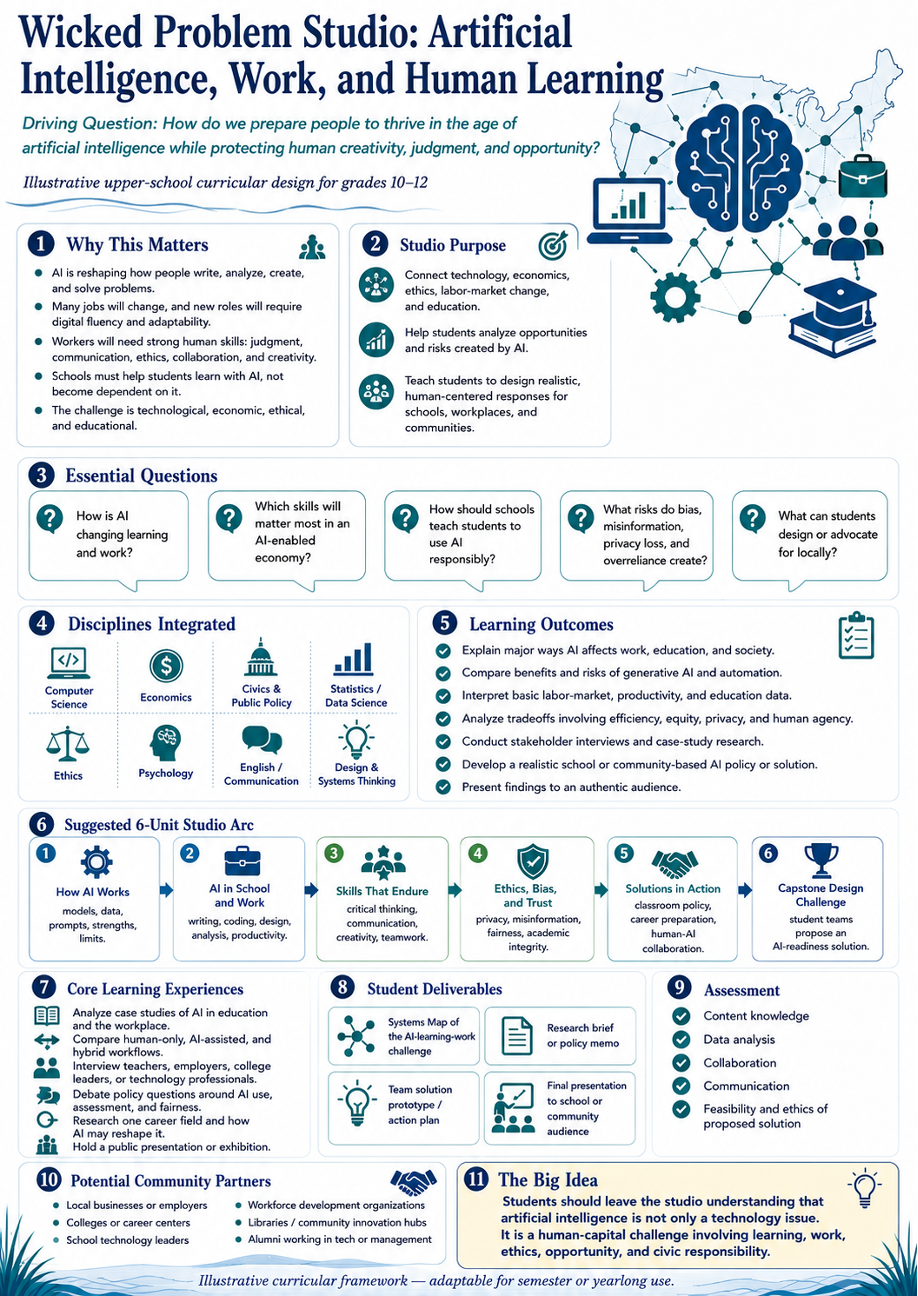
I thought the six-unit Studio Arc created by ChatGPT Pro was reasonable. I believe it’s reasonable to assume each unit lasts six weeks. If I were developing the studio, I could use this outline to create the units, then develop specific assignments for each week in each unit. I like the idea of the Capstone Design Challenge for the sixth and final unit. I may consider developing the six-unit, 36-week Studio for a future post.
Dual Enrollment With Purpose
As more students earn college credit during high school, independent schools need to be thoughtful about how those credits fit into the larger student experience. Dual enrollment can be valuable, but only when it is connected to a purpose.
The question should not be, “How many college credits can a student earn before graduation?” The better question is, “How does this course help the student build readiness, explore a field, develop a skill, or create future optionality?”
Some students may use early credits to accelerate their studies. Others may use them to make room in college for study abroad, research, internships, a double major, or a more demanding academic sequence. Still others may use a college-level course to test whether a field truly interests them.
Schools should also teach credit literacy. Students and families need to understand the difference between earning credit, receiving placement, and having a course apply to a major or graduation requirement. A credit that appears impressive on a transcript may not help much if it does not transfer or apply in a meaningful way.
Before enrolling in a dual enrollment course that is not part of the basic general education pathway, students should be able to explain how the course fits their emerging Field of Study, academic readiness, and future plans.
The non-profit Education Design Lab (EDL) (full disclosure: I am a Board member) initiated the Career Ready by Design project to strengthen dual enrollment pathways in the state of Georgia. Their design question for that project is: “How might we design clear, transparent dual-enrollment and learn-work pathways that make expectations explicit, align coursework with meaningful credentials, and eliminate the hidden complexities that leave learners feeling lost?”
The EDL project is currently working with five community colleges and 15 public high schools. The project’s goal of having high school students earn before graduation “at least 12 transferable credits with explicit connections to credentials, degrees, and career pathways aligned with regional workforce needs” is very much aligned with the purpose stated above. Paying attention to the outcomes from this work could be insightful for private and public schools alike.
College Navigation Is a Skill
One of the most overlooked forms of college readiness is knowing how college works. Many students arrive on campus without understanding degree maps, prerequisites, office hours, advising, add/drop deadlines, transfer credit, general education requirements, or the difference between a major, minor, certificate, and concentration.
Independent schools can teach this directly.
By senior year, students should know how to read a college catalog, email a professor, prepare for an advising appointment, ask whether a course fulfills a requirement, and think strategically about their first year. They should understand that college is not only a set of courses. It is an ecosystem of faculty, peers, advisers, offices, research opportunities, internships, alums, and support systems.
Students who know how to navigate that ecosystem will be better positioned to thrive.
A New Standard for College Preparation
The independent school promise should extend beyond college admission. It should include preparation for what happens after the acceptance letter.
A strong grades 9–12 program could include a Learning Map, Field of Study advising, Research Investigative Inquiry, Wicked Problem Studios, credit-literacy education, experiential learning, and a senior presentation in which students explain what they have learned about themselves and how they intend to use college well.
The final question for graduates should not only be, “Where are you going to college?” It should also be, “How are you prepared to make the most of it?”
That is the deeper opportunity. Independent schools can help students graduate not as passive consumers of a curriculum, but as thoughtful orienteers; specifically, young people who know how to explore, connect, question, adapt, and build purposeful lives.