Jeff Selingo wrote Dream School for families. College leaders, especially those at tuition-dependent, four-year residential undergraduate institutions, should read it as market research. Across the book, a consistent message emerges: Outside a small group of elite institutions, families increasingly want proof—not promises—of career preparation, hands-on learning, belonging, affordability, and institutional capacity.
That means yield is no longer primarily an admissions communications problem. It is a problem of institutional design and evidence.
Why Yield Has Become a Proof-of-Value Problem
In this article, yield refers to the percentage of admitted students who enroll. Some of the institutional improvements discussed below affect yield directly, while others strengthen demand, retention, and reputation over a longer period.
In the book’s introduction, Selingo notes that he conducted two surveys of more than 3,000 parents before writing the book. There were two outcomes he views as significant.
- College is mostly about the job afterward.
- Parents’ highest-ranked attribute of a good college was the availability of experiential learning, such as internships and research projects.
- The second-highest-ranked attribute was graduates’ job placement.
- Prestige isn’t worth any price.
- Hands-on learning and job placement received more votes than prestige, even at the highest household income level (+$250,000).
Application growth has given students more choices without proportionately increasing the number of students available to enroll. As a result, colleges outside the most selective tier must demonstrate value earlier and more specifically.
Today’s Early Action applications are like the Regular Decision applications of a generation ago, according to Selingo. Students like EA because they get a quicker response. Students usually include at least one school with EA in their college application pool. Colleges receiving EA applications should offer every admitted EA applicant a meaningful opportunity to visit the college in person or virtually.
Despite having more application options, the author recommends students should never rule out a school before they visit and should never enroll in one sight unseen. Colleges should track the percentage of admitted students who engage, the form of engagement, and their subsequent yield.
By 2024, approximately 20 percent of applicants applied to 10 or more colleges. That percentage is even higher with applicants from affluent families.
According to Niche.com data, when students are in ninth grade, the colleges on their list have the widest range of rankings. By July of the summer before the average student’s senior year, the range narrows substantially.
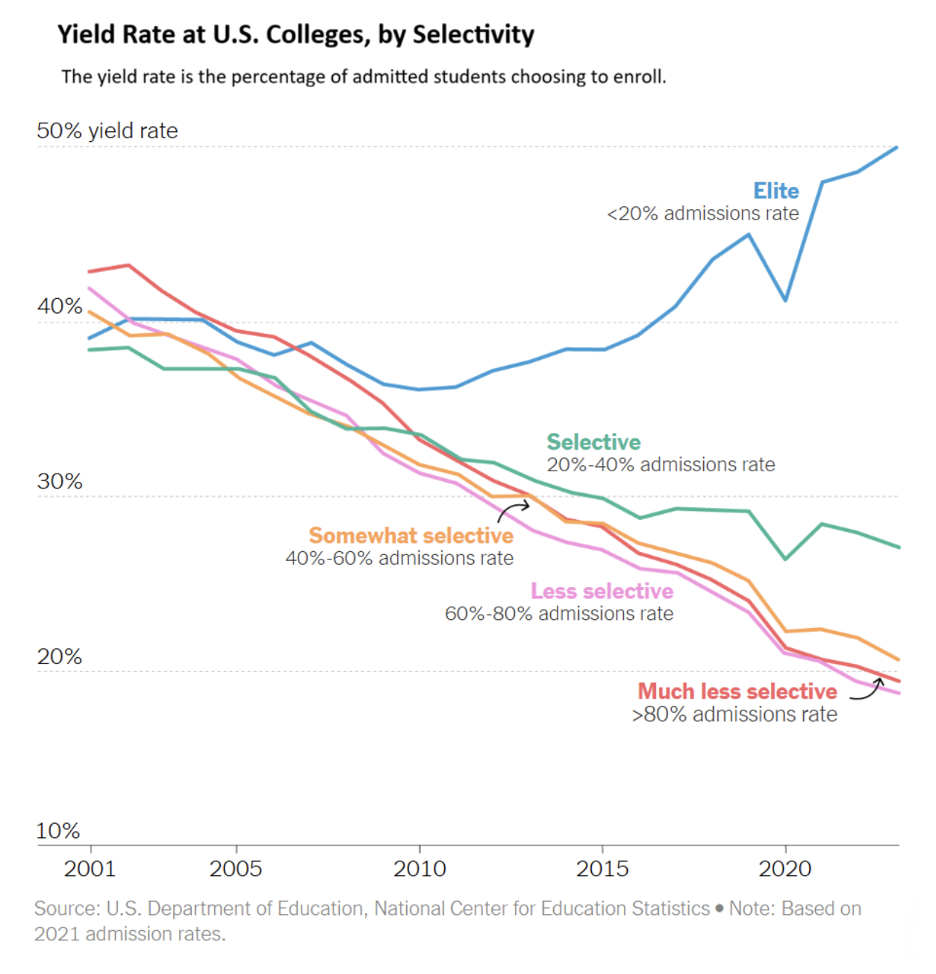
The higher application volume post-COVID contributed to lower reported yield rates (the percentage of accepted applicants who enroll) at all but the most selective colleges. The impact is evident in the U.S. Department of Education’s National Center for Education Statistics (NCES) graph below, I obtained from the New York Times (a similar chart is in Dream School). The chart below is based on 2021 admission rates.
Five Imperatives for Improving Yield
(1) Prove Career Value by Program
Selingo writes that prospective students should ask many questions about a college regarding what the job search looks like for graduating students. He recommends the following:
- Visit career services during the campus visit – request a list of companies that have hired students over the past three years who graduated from the intended degree program.
- Use LinkedIn to look at early career paths of graduates from the intended program.
- Ask what alums do to help students get jobs.
- Know the hiring calendar for interns in the field of interest.
Many institutions report first-destination outcomes within six months of graduation, including employment and continuing education.
The National Association of Colleges and Employers uses a six-month first-destination framework and emphasizes the knowledge rate, the percentage of graduates for whom the institution has verifiable outcome information. A high percentage is not meaningful without knowing how much of the graduating class is represented.
I would recommend that institutions publish:
- Career outcomes rate by program (or their programs comprising 80 percent of enrolled students)
- Knowledge rate by program
- Top employers and representative job titles
- Graduate and professional-school destinations
- Representative alum career pathways
- Internship participation rates
- Earnings data, with the cohort, coverage, and measurement period clearly explained
Well-informed families look for lists of employers that recruit on campus, as well as the number of job offers that students in each program receive after graduation. The College Scorecard provides program-level median earnings for former students who received federal financial aid, completed an award, and met the employment and enrollment conditions used for the measure.
Comparing earnings data between the same program at different schools is difficult. Selingo suggests that his simple ratio of overall average earnings divided by overall net price is an important metric to consider. One reason is because earnings comparisons can favor elite institutions where many recent grads are employed in finance, consulting, or technology.
Leaders of a tuition-dependent four-year college with low yield rates should provide many of these metrics online or as part of their prospective applicants packet:
- List of employers hiring graduates
- The percentage of students hired by first-destination outcomes by program, including the knowledge rate
- Representative alum career pathways by program
- The number and percentage of students matriculating in graduate school
- Earnings information by program
- Career Services and employer partnerships by program
Strong answers can distinguish an institution; weak answers reveal areas that require sustained investment and improvement.
(2) Emphasize Value Over Prestige
Unless their child gains admission to one of the most prestigious institutions, Selingo writes that many wealthy families have decided that the high tuition, fees, and room and board don’t make sense anymore. He notes this trend began with the passage of the HOPE scholarship in Georgia in the early 1990s.
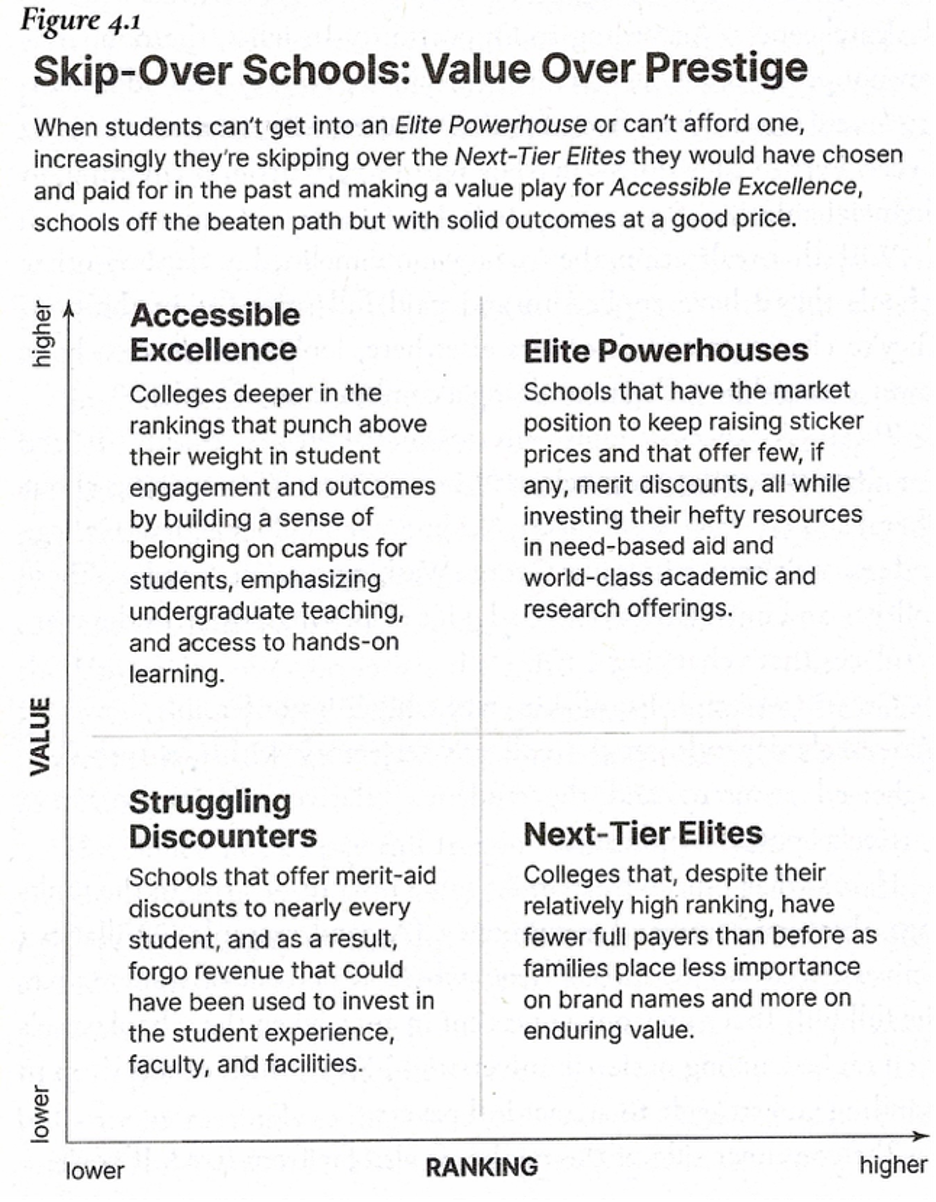
In Figure 4.1 below, Selingo provides a four-square matrix that groups colleges into Elite Powerhouses (high ranking, high value), Next-Tier Elites (high ranking, lower value), Accessible Excellence (low ranking, high value), and Struggling Discounters (low ranking, low value). Students who can’t get into an Elite Powerhouse or afford one are skipping the Next-Tier Elites and enrolling in the Accessible Excellence institutions.
Colleges with enrollment issues want to avoid moving into the Struggling Discounters box or, if in it, want to find a way to move up to the Accessible Excellence box.
Colleges should lead with clear net-price information and credible evidence of outcomes rather than the average merit award. Families ultimately evaluate what they will pay and what the educational experience is likely to deliver, not whether their award is described as above average.
Selingo cites a Sallie Mae and Ipsos survey that found that 81 percent of today’s families with a six-figure income cross a college off their list at some point because of cost. He notes that only 61 percent did that in the mid-2010s. Colleges need to understand their discounting strategy, monitor it carefully, and analyze material variances from target.
(3) Guarantee Experiential Learning (not just promise it)
During his search for an answer to what makes a good college, Selingo visited the Center for Postsecondary Research at Indiana University. Indiana has conducted the National Survey of Student Engagement (NSSE) for decades. The survey looks for evidence of engagement on campus and surveys first-year and senior students about their participation in educationally purposeful activities. Selingo recommends asking colleges for their NSSE results while noting that a few publish them online.
While NSSE would not give Selingo the results of individual colleges, its staff agreed to provide him with a report of aggregated data from 1,200 colleges that he sorted based on selectivity of admissions.
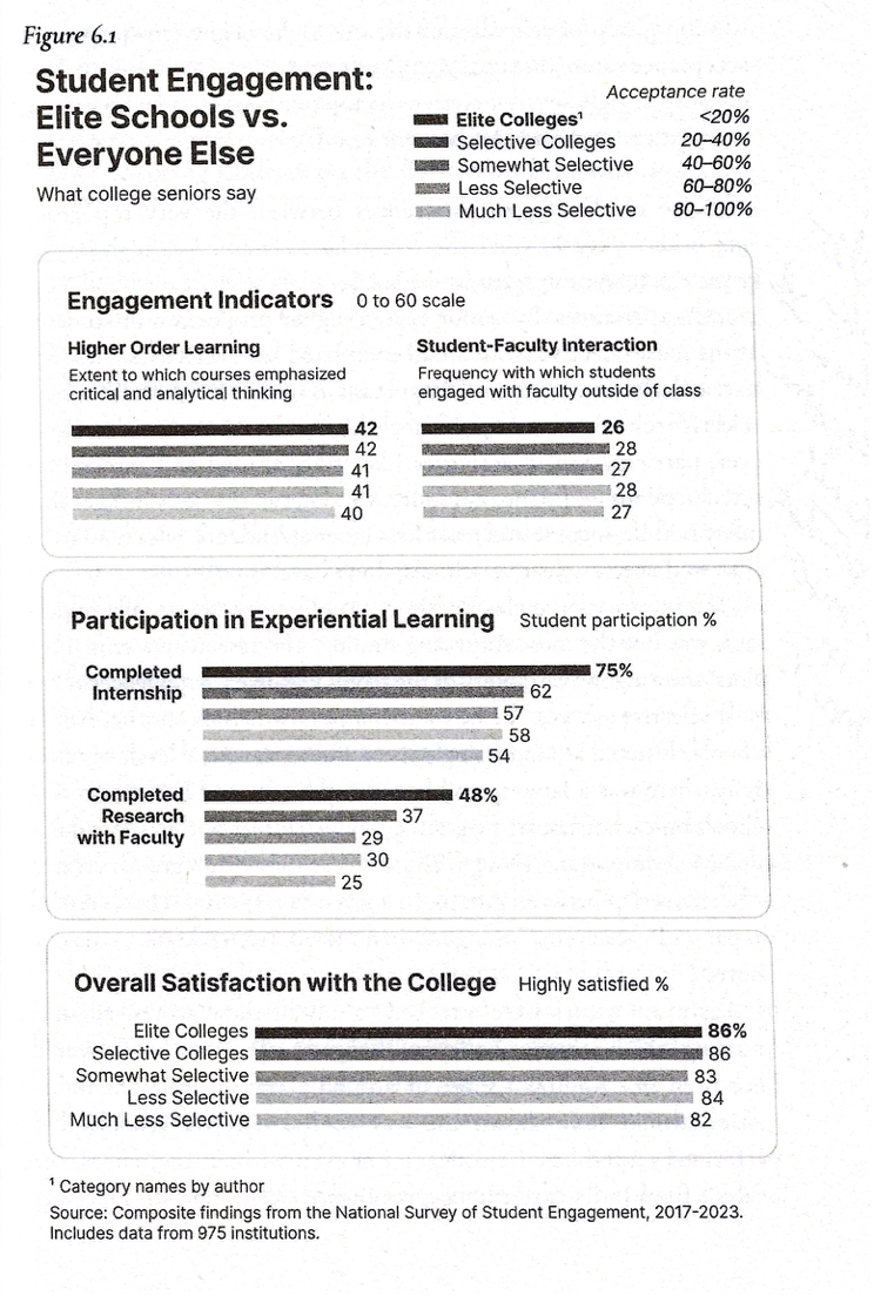
Figure 6.1 below (source: Dream Schools) provides aggregated data from college seniors. Note that there is very little difference in engagement between the categories of Engagement in Higher Order Learning and Student-Faculty Interaction, as well as Overall Satisfaction with the College. The differences lie with the student participation rates in Experiential Learning, Completed Internships, and Completed Research with Faculty.
Since the last category was cited as very important by parents in Selingo’s original 3,000 parent survey, colleges should be transparent about the percentage of students participating in Experiential Learning.
Senior capstones in most, if not all, degree programs are highly recommended practices for demonstrating program learning outcomes. If these are standard practices, colleges should tout these experiences in their promotional materials. If they are not part of the curriculum, they should consider adding them. It’s important to note that capstones are not automatically substitutes for internships, employer interaction, or professional experience.
Most colleges do not publish information about the skills that students receive. Colleges offering certificates and micro-credentials that provide skills training should promote those offerings in their catalog.
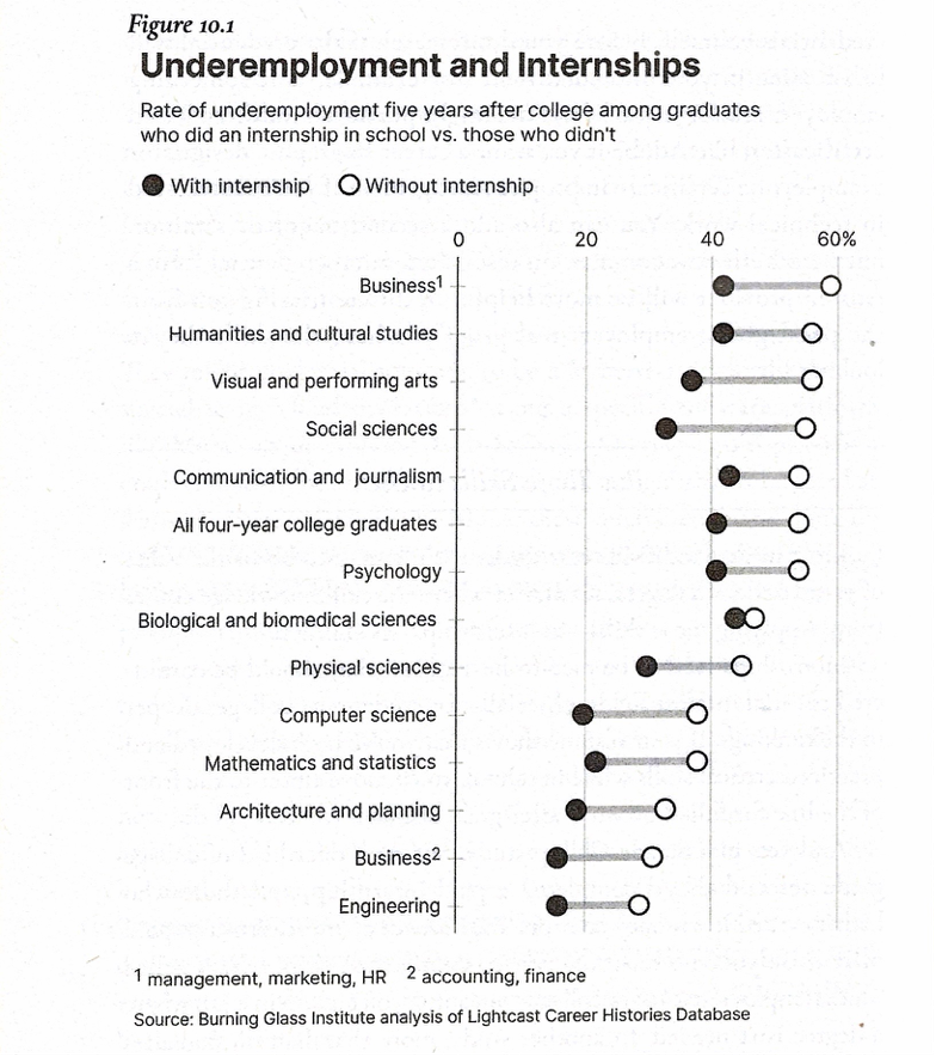
Colleges should also publish internship opportunities for their students. Selingo argues that the data he cites show a strong association between completing an internship and lower subsequent underemployment. In Figure 10.1 below, he illustrates the variance in underemployment between graduates with internships and those without. Prospective students should find out how many internships the average student receives during their undergraduate years.
Programs with built-in internships or work experience are a plus. Job shadowing and externship programs are additional opportunities that enhance a student’s employability.
An experiential-learning guarantee is credible only when the institution provides the financial and logistical support necessary for all students to participate. A meaningful guarantee would ensure that every undergraduate has access to and completes at least one substantial, supervised experience before graduation, such as an internship, co-op, clinical placement, faculty-guided research project, field experience, or community-engaged project.
Forms of support may require stipends, transportation assistance, temporary housing, professional clothing, disability accommodations, or compensation for students who must reduce paid work hours to participate.
(4) Make Belonging and Mentorship Visible
Parents surveyed by Selingo indicated that nothing mattered more than a college’s commitment to student success. Students succeed because of people. College professors are frequently students’ first and most accessible mentors. Very few ranking systems attempt to measure teaching and mentorship.
Dream schools are often those where faculty members focus on teaching and engaging with undergraduates. Selingo argues that teaching-focused institutions may provide more accessible mentorship than their rankings suggest, while prestige alone does not guarantee close faculty engagement.
Selingo cites Corbin Campbell’s research that found that higher-ranked colleges scored lower than lesser-known schools in teaching and engagement. Teaching was strongest at liberal arts colleges, both higher and lower in the rankings.
During a college search, Selingo suggests that students:
- Find out how the school hires its faculty – do they give teaching demonstrations when they are hired, and are undergraduates invited?
- Ask current students about their professors – seek students in the potential major on LinkedIn or ask the department chair or admissions office.
- Sit in on a class, preferably in the program of interest – ask to attend a class while visiting.
A good college will not let a student “sink or swim”, Selingo writes. Good colleges provide an infrastructure or support framework from the first week of freshman year onward. Major rankings rarely measure belonging directly.
Belonging changes with context and experience according to Selingo. The act of participating in college matters. Belonging is not limited to only the social aspects of college. Students benefit, writes Selingo, from belonging’s cumulative effects in three domains of undergraduate life: academic, residential, and extracurricular. Finding a college that helps its students fit in all three should be critical to any student’s search process.
Selingo suggests that students look for these components:
- A supportive start – look for colleges that have a full-fledged “first-year experience” with intro-to-college courses, programming in the residence halls, and advisors that build scaffolding around a student’s early undergraduate years and slowly remove it to allow them to independently function.
- Easy connections – students thrive when they feel like they belong. Pay attention to how students interact on the tour. Are faculty accessible outside of class? Which faculty teach the intro classes? How many students remain on campus on weekends?
(5) Align Enrollment Strategy with Financial Sustainability
Selingo outlines a simple formula for calculating a college’s net revenue.
Sticker Price x Enrollment = Gross Tuition Revenue – Discounts = Net Tuition Revenue
A college that increases its enrollment by 10 percent can see a shrinkage in its net revenue when it increases its discounts to enroll those additional students. Widespread merit discounting can reduce the resources available for the student experience unless it is offset by sufficient enrollment volume or other revenue. The net price to a student includes, as a deduction from the cost of attendance, all federal, state, and institutional grants. It reflects the true cost of college for a student and is important for most families considering college.
Offering a merit aid discount to 100 percent of applicants makes it difficult to move up. At a minimum, don’t promote your average merit aid award. After all, isn’t everyone’s child “above average”? Colleges might pair selected merit aid awards with guaranteed, funded experiential-learning opportunities, thereby strengthening the value of the award without simply increasing its dollar amount.
Selingo notes that there is no single indicator of financial well-being that puts a college on stable ground. He suggests three key metrics for review. These are:
- Bond-rating reports (when available)
- Enrollment and endowment data
- A mix of majors with healthy student enrollments
What Dream School Gets Right and What Leaders Should Test
Dream School is strongest as a synthesis of how families perceive the value of college. Its surveys and examples of individuals and institutions provide college leaders with useful hypotheses about what matters in the enrollment decision.
Parent surveys measure stated preferences, not necessarily the factors that cause an individual student to enroll. Institutions should test Selingo’s findings against their own admitted-student surveys, engagement data, aid packages, lost-enrollment interviews, and retention outcomes.
Responding to families’ concern about employment does not require reducing college to job training: it requires making the connection between learning, personal development, and post-college opportunity more visible.
Lastly, Selingo provides a list of 75 non-elite schools that he classifies as a Dream Schools list. Obviously, this is a great list for parents. Assuming you are the leader of a school that is not listed, I recommend reviewing that list for schools that are considered your competitor. There are several paragraphs of comments provided by Selingo that may be insightful for why a competitor school was listed and yours was not.
What Dream School Underplays: AI and the Changing First Job
One consequential issue sits largely outside the book’s framing. Specifically, generative AI is changing the entry-level work for which colleges prepare students. That development makes Selingo’s emphasis on experiential learning even more urgent. Colleges cannot simply add a general AI-literacy module. They must redesign projects, internships, curricula, and career preparation around AI-augmented work, verification, judgement, and workflow design.
College leadership teams focusing on improving their experiential and job placement opportunities to attract more students need to be mindful of the impact of AI on the recruiting and hiring of their graduates. They should ask these questions:
- Are academic programs identifying the tasks in their fields that AI is changing?
- Are employer partners helping redesign internships?
- Are students practicing how to verify AI output and exercise judgment?
- Are career-outcome measures capturing changes in entry-level roles and required skills?
Measuring Impact of Initiatives
Most colleges and universities have many different metrics that they track on a regular basis. If leaders pursue these imperatives, I recommend considering tracking the following:
| METRIC | WHY IT MATTERS |
| Yield by major, net price band, geography | Identifies where value breaks down |
| Net tuition revenue per student + discount rate | Tests enrollment gains for financial gain |
| Admitted student engagement-to-deposit % | Which experiences influence enrollment |
| Deposit-to-enrollment melt | Does engagement occur post-deposit? |
| Experiential learning completion | Whether access is universal or anecdotal |
| Career outcomes by program | Whether published outcomes are useful |
| First-year to second-year retention | Whether the enrollment promise is delivered |
| Mentor or advising participation | Whether belonging/support is provided |
The objective is not to maximize yield at any cost. It is to enroll the desired class at a sustainable level of net tuition revenue.
Final Thoughts
Dream School is valuable to intended audience, parents of prospective college students. It is also valuable to college leaders because it turns family concerns into institutional questions. The objective is not to maximize yield at any cost, but to enroll a class that sees credible value in the institution at a price families can sustain and at net tuition revenue the college can support. That requires program-level career evidence, equitable access to experiential learning, visible structures for mentorship and belonging, transparent pricing, financially disciplined enrollment management, and a redesigned bridge to AI-shaped work.
Colleges will not improve yield by telling a better story about an unchanged experience. They will improve it by building a stronger value proposition and proving that it is real.