
I have been a fan of the large workforce-related datasets that the Burning Glass Institute utilizes for its frequent research. A new report issued last week by the NYU School of Professional Studies and the Burning Glass Institute, titled Sidetracked: The Hidden Crisis in Mid-Career Mobility, puts a name and a number to a problem white-collar workers have recognized for years: that being employed is not the same as moving forward.
The paper’s headline finding is not surprising. Approximately 24 percent of mid-career professionals are “stalled,” meaning they have gone 5 or more years without a meaningful promotion and have experienced less than 5% real wage growth. In other words, roughly one in four mid-career professionals may be working steadily while their careers quietly flatten.
That distinction is the report’s greatest contribution. Most public discussion of labor market health still turns on binary measures such as employment versus unemployment. The paper’s researchers argue that a worker can have a job, a paycheck, and even a college degree, and still lose economic momentum.
The report opens with “Sarah,” a 42-year-old college-educated professional with 15 years of experience whose salary has barely kept pace with inflation and whose upward trajectory has disappeared. Sarah is fictional, but she serves as a useful stand-in for the report’s finding that America has a mobility problem within employment, not just outside it.
The authors draw on Burning Glass Institute’s career-history database, which covers tens of millions of U.S. workers. They narrow the analysis to more than 1.3 million relevant career histories. The focus is primarily on college-educated, office-based professionals in fields such as business and management, clerical and administrative services, IT and math, IT support, and sales and customer service. The researchers define the mid-career window as years 10 to 15 of a worker’s career and classify someone as stalled only when both conditions are met: no promotion for 5 consecutive years and less than 5% wage growth over that same period.
That dual definition makes sense. A worker might go several years without a title change but still receive meaningful raises. Another might receive a cosmetic promotion without real economic progress. By requiring both wage stagnation and promotion stagnation, the researchers try to isolate a deeper plateau rather than normal career variation.
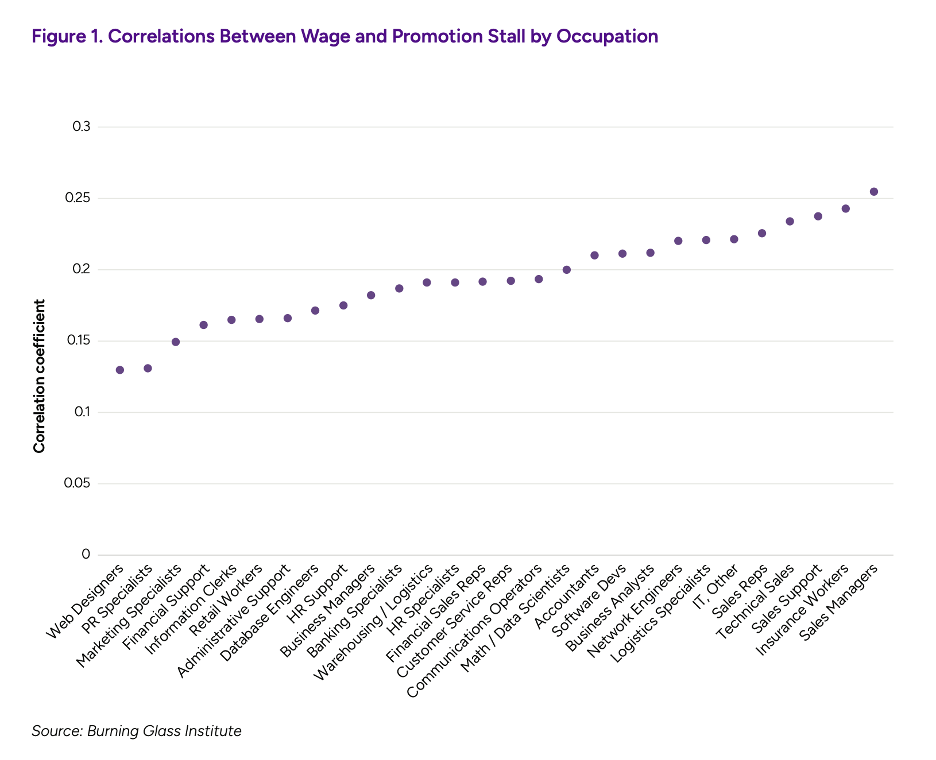
Figure 1 below is especially helpful. The graph shows that wage stall and promotion stall are correlated, but only modestly, across occupations (a reminder for non-statisticians – with datasets as large as Burning Glass’, even a small correlation coefficient can be significant). That supports the authors’ decision to treat the two as related but distinct dimensions of career health.
The report’s descriptive findings are striking. Stall varies meaningfully by industry, geography, occupation, gender, and race.
Figure 2 below shows industry stall rates ranging from 20.7% in information to 30.2% in public administration.
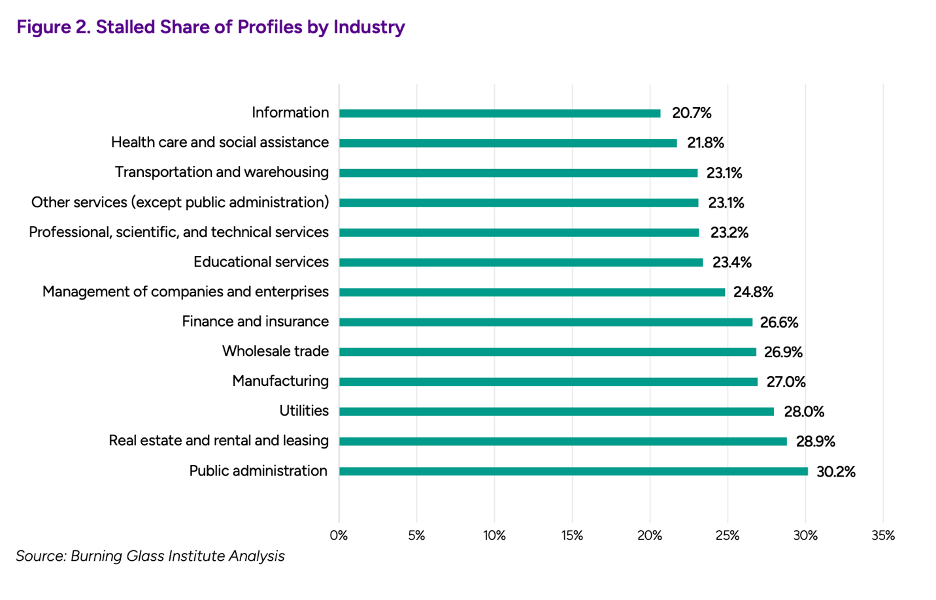
Figure 3 below is a state-level heat map showing lower stall rates in large, dynamic economies such as Washington and California, and higher rates in states with smaller or less diversified labor markets.
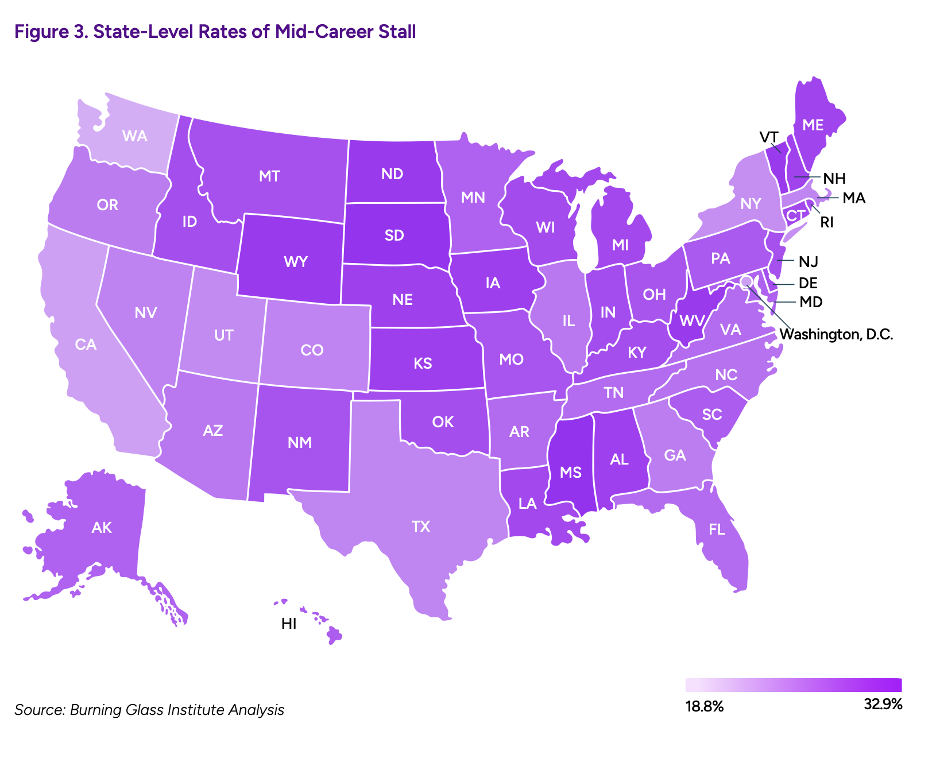
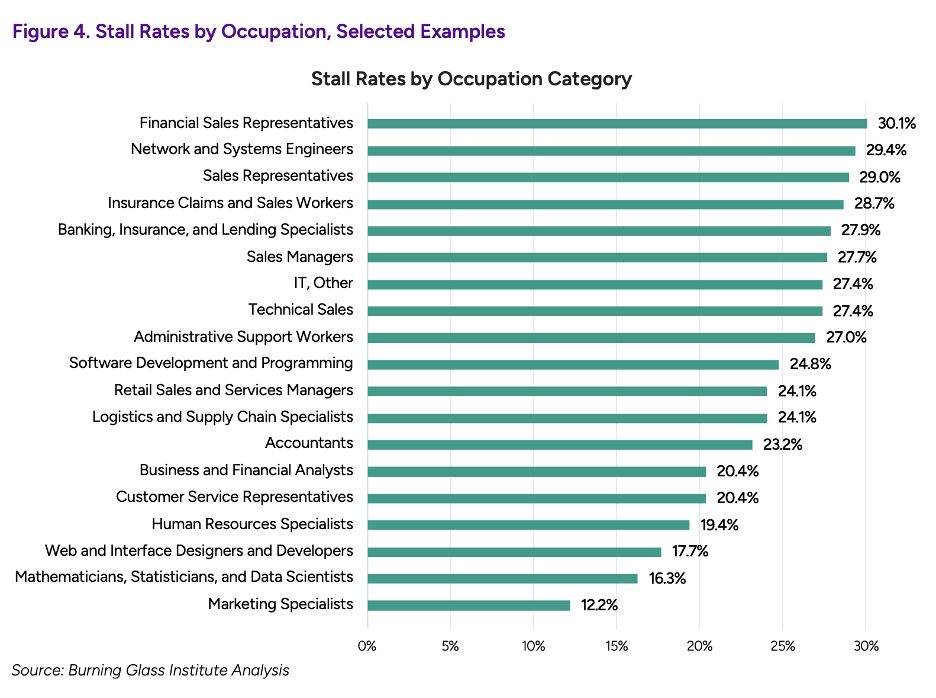
Figure 4 below provides an occupational chart illustrating the variance in stall rates among selected occupations. The figures highlight especially high stall rates among financial sales representatives, network and systems engineers, sales representatives, and insurance claims and sales workers, while marketing specialists and data scientists appear much less likely to stall.
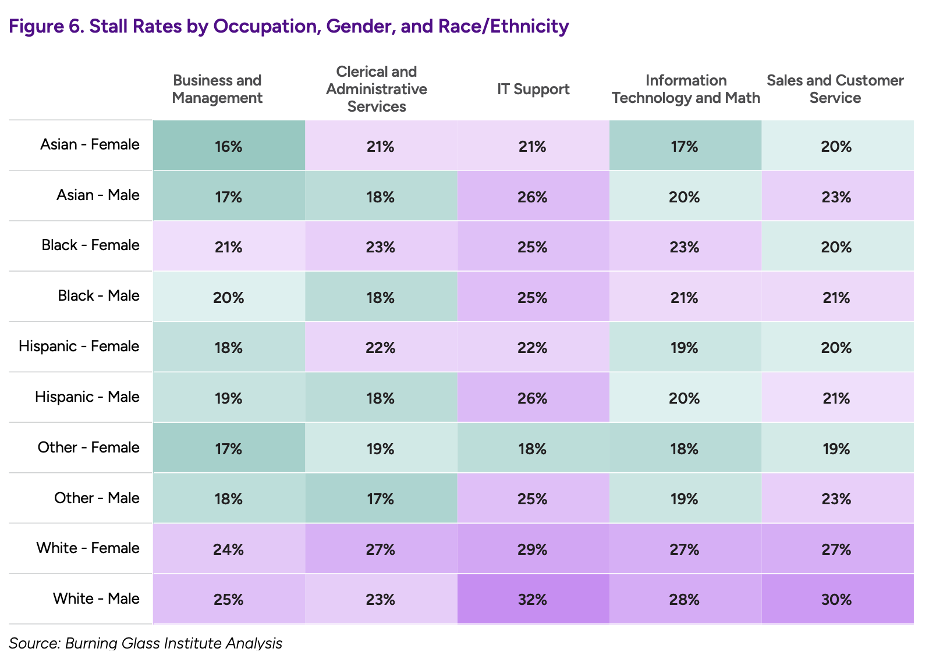
One of the report’s more interesting arguments is that stall is not random, but neither is it explained by simple demographic disadvantage alone. A gender chart shows women stalling at higher rates in clerical and administrative roles, while men stall at higher rates in several other categories, including sales and customer service.
Figure 6 below highlights differences in stall rates by race and gender across several sectors. White professionals show some of the highest stall rates within several occupational categories, while Asian professionals often show lower rates. The authors interpret this cautiously, arguing that stall risk appears to be shaped heavily by the “architecture” of occupations—how ladders, roles, networks, and advancement norms are built—rather than by demographic identity alone. They also note that women have higher stall rates than men in all races and industry sectors.
The most useful insight in the paper may be that mid-career stall often begins earlier than mid-career. By year ten, workers who will later stall are already behind their peers. The report finds that future stallers average 1.5 internal promotions and 30% wage growth in their first decade, compared with 1.9 promotions and 71% wage growth among those who do not stall. That is a large early gap, and it changes how we should think about intervention. If a plateau becomes visible only after 15 years, employers and workers may see it as a fixed fact. But if the warning signs appear by year ten, there is a window for action.
The paper’s section on credentials is also valuable because it avoids the simplistic claim that “more education” always solves mobility problems. Advanced degrees reduce stall risk somewhat. According to the report, 25.3% of bachelor’s degree holders stall, compared with 20% of master’s degree holders and 18.5% of doctorate holders.
But the bigger story is non-degree credentials. The authors find that non-degree credentials are associated with a 29% average reduction in stall likelihood, while high-quality, market-aligned credentials are associated with a 52% reduction. The report also finds that credentials can be associated with higher stall risk in some fields, including public administration, engineering, and business management. This is a smart and important distinction. A credential only helps if employers in that field treat it as a signal of advancement-readiness, not merely entry-level competence.
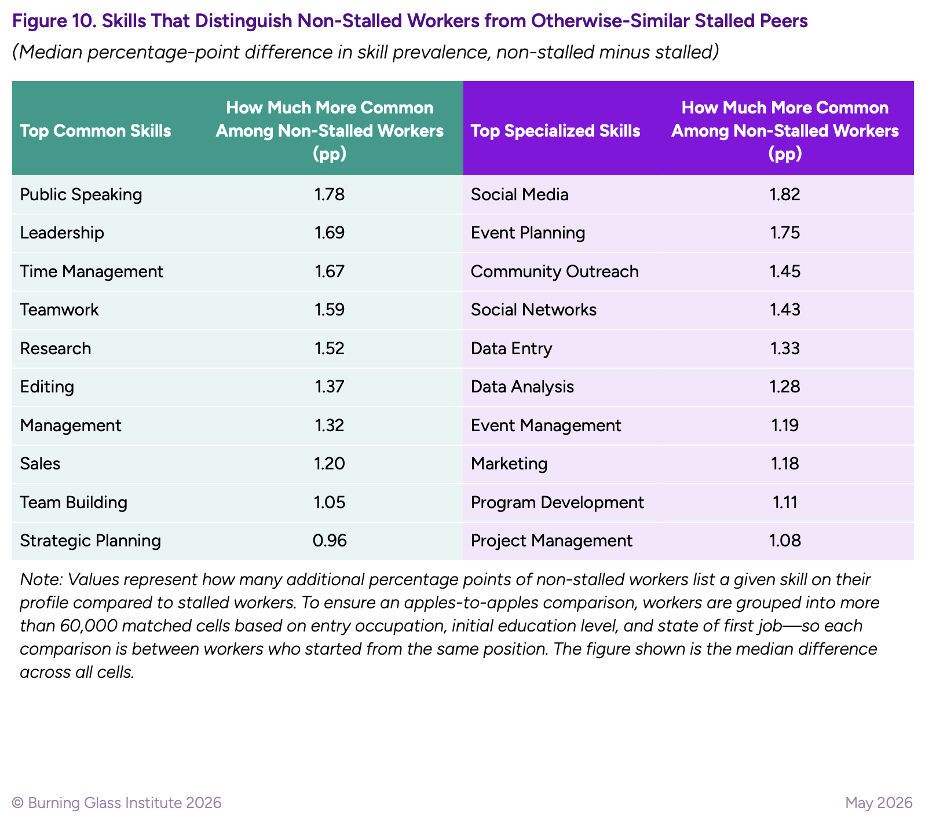
The solutions section is practical. Figure 10 below identifies common and specialized skills more common among non-stalled workers than stalled peers, including public speaking, leadership, time management, teamwork, research, management, strategic planning, social media, event planning, data analysis, and project management. These are not just narrow technical skills. They are skills that help workers move beyond task execution into coordination, influence, analysis, and external engagement.
The report then offers three archetypes for escaping stall. Computer programmers can “deepen” by moving toward software development, quality assurance, systems architecture, or data science. Cost estimators can “broaden” into project management, budget analysis, logistics, or management analysis. Office managers can “change domains” by shifting their focus to business operations or management analysis.
An Informative but Imperfect Report
The paper has a few limitations. First, its headline statistic risks being read too broadly. “One in four professionals” is memorable, but the sample is not the entire workforce. The appendix makes clear that the analysis is concentrated among college-educated workers in office-type occupations, with exclusions for sectors such as skilled manual labor, healthcare, and education in the core sample. That focus is defensible, but the headline should be handled carefully for anyone describing the report’s findings. The statistic does not represent one in four American workers, or even one in four workers across every professional field. It is closer to 1 in 4 mid-career, college-educated professionals in the kinds of knowledge-work roles captured by the Burning Glass dataset.
Second, the wage data are estimated, not observed payroll records. The report says salaries are built from private salary survey sources and matched to job histories using job title, occupation, employer, state, and year. That is a reasonable method for large-scale labor market research, but it introduces uncertainty. A worker’s true compensation may differ meaningfully from an estimate, especially in roles where bonuses, commissions, equity, overtime, or geographic pay bands matter. This is especially relevant because the definition of stall turns partly on a 5% wage-growth threshold. Small measurement errors could change classification for workers near the cutoff.
Third, promotion is difficult to measure from profile data. Title changes are messy. Some companies inflate titles; others keep titles flat while expanding scope and pay. Some workers change employers for better opportunities without receiving a title that appears to be a promotion. The report’s dual metric helps reduce this problem, but it cannot eliminate it. “No meaningful promotion” is conceptually clear, but operationally difficult.
Fourth, the report sometimes moves close to causal language while relying largely on observational data. To its credit, the paper acknowledges the sorting-versus-causation problem. Workers who stall may have experienced limited opportunities, but they may also differ in motivation, fit, preferences, caregiving constraints, risk tolerance, health, or other unobserved factors. The same issue applies to credentials. A high-quality credential may reduce stall risk, or people with stronger career momentum may be more likely to pursue and complete high-quality credentials. The authors are aware of this, but readers should be careful not to treat every association as a proven intervention effect.
Finally, the demographic interpretation deserves caution. The finding that some historically advantaged groups stall at higher rates within certain occupations does not mean bias is absent or unimportant. The report does note that sorting into occupations is itself shaped by inequality. That point should be emphasized. A worker may have a lower stall rate after reaching a management track, while still facing unequal odds of getting onto that track in the first place. Within-occupation stall rates are only one part of the mobility story.
What are Mid-Career Stalls to Make of This?
Overall, Sidetracked is a strong and timely report because it reframes career success in terms of momentum rather than just employment. Its best insight is that career stagnation is often detectable before it becomes permanent. Its best policy implication is that employers should not wait until mid-career workers are visibly stuck before offering mobility pathways, targeted credentials, mentoring, stretch assignments, and internal transitions. Its main weakness is that its strongest claims rest on data and methods that are powerful at scale but imperfect at the individual level.
For workers, the takeaway is not panic, and it is not another round of vague self-improvement. The practical question is sharper: Am I still gaining scope, marketable skills, and wage momentum? For employers, the question is even more direct: How many capable people are sitting in roles where the ladder has quietly ended?
The report’s most important contribution is to make that hidden plateau visible. Employment may keep people afloat, but momentum is what carries careers forward. I was glad to read a paper where researchers attempted to statistically confirm what senior leaders have known for years, that a certain percentage of professionals fail to move ahead at the pace of others. Given the costs of recruiting and training employees, this could help direct and coach them before they fall too far behind their peers.