After updating my December 2025 and January 2026 reports on a few enrollment, operating, and financial statistics for private colleges in Maryland and Virginia, I thought I should follow up with an update on Florida’s private colleges.
My original Florida private colleges post was in January 2026, a week after my post about Virginia’s private colleges. I compiled data about the member colleges of the Independent Colleges and Universities of Florida (ICUF) from the College Navigator website. I repeated that process for updating my data for this article.
Just as I excluded data from Washington & Lee, Liberty University, and the University of Richmond from the Virginia mean, median, high, and low statistics, I excluded data from three Florida private universities: Full Sail University, Keiser University, and the University of Miami. The University of Miami was excluded based on its admissions selectivity and endowment balance. Keiser University was excluded due to its multiple campuses, online enrollments, and a lack of published enrollment information. Full Sail was excluded based on its high enrollments, the majority of which are online.
Enrollment
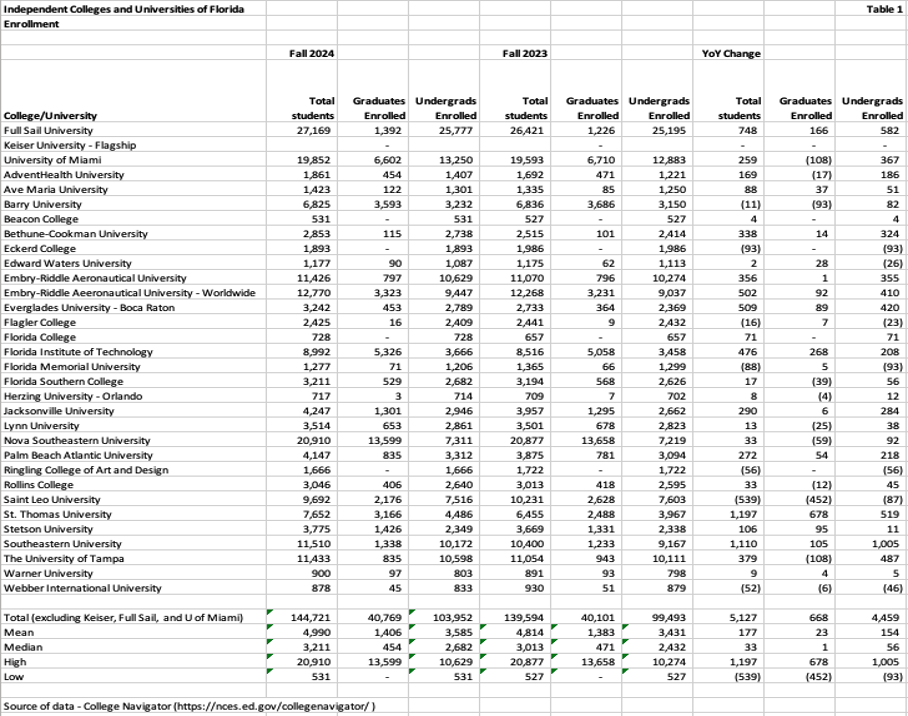
I listed the ICUF member institutions and their enrollment totals for undergraduate and graduate students in Table 1 below. The first set of three columns represents Fall 2024 enrollments, the current data provided by College Navigator. The second set of three columns represents Fall 2023 enrollments, the data that was available as of 12/19/25 when I downloaded the data in order to prepare to publish my January 2026 article.
The means, medians, highs, and lows for the group of 32 exclude Full Sail University for good reason. Its undergraduate student population is more than double the next four highest colleges and universities.
The remaining 29 colleges and universities saw their aggregate enrollments increase by 5,127 year-over-year, with most of that increase represented by an aggregate gain of 4,459 undergraduates. The aggregate number of grad students enrolled increased by 668. The mean change for the group was an average increase of 177 students versus a median change of 33 students.
Individual colleges varied widely, with the highest total enrollment gain at St. Thomas University (+1,197 students) followed by Southeastern University (+1,110 students), Everglades University (+509 students), Embry-Riddle Aeronautical University Worldwide (+502 students), Florida Institute of Technology (+476 students), the University of Tampa (+379 students), Embry-Riddle Aeronautical University (residential campus) (+356 students), Bethune-Cookman University (+338 students), and Jacksonville University (+290 students).
Saint Leo University experienced the greatest decline in enrollment (-539 students), followed by Eckerd College (-93 students), Florida Memorial University (-88 students), Ringling College of Art & Design (-56 students), Webber International University (-52 students), Flagler College (-16 students), and Barry University (-11 students). Clearly, the demographic cliff is not yet visible in Florida, with few colleges experiencing major enrollment declines.
There are four private colleges in Florida with no graduate student enrollment and six with fewer than 100 graduate students. These include Warner University (97 students), Edward Waters University (90 students), Florida Memorial University (71 students), Webber International University (45 students), Flagler College (16 students), Herzing University – Orlando (3 students), Beacon College (none), Eckerd College (none), Florida College (none), and Ringling College of Art & Design (none).
Admissions Selectivity
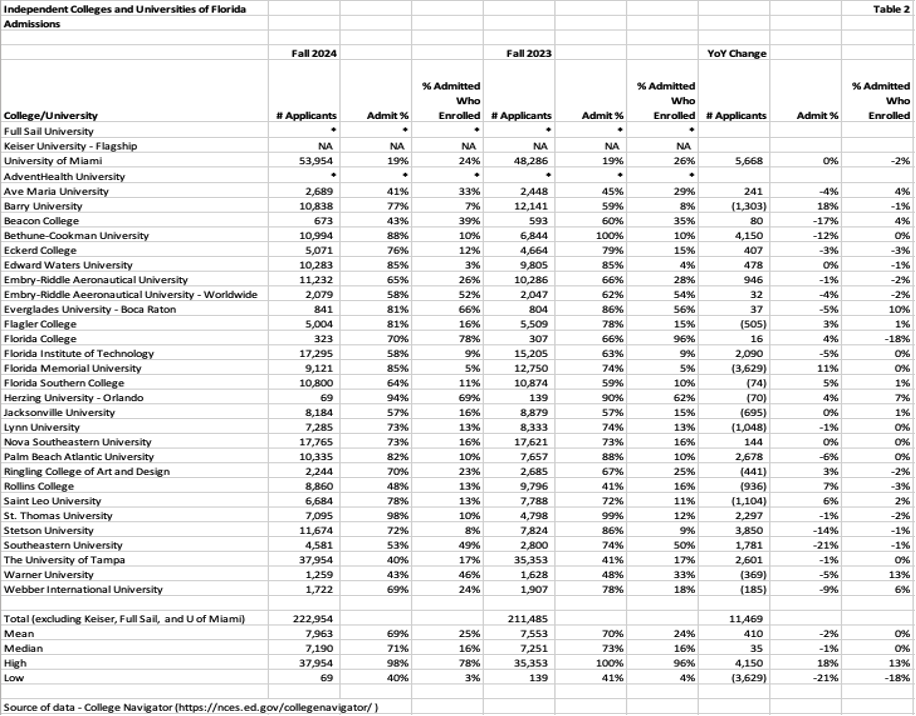
Table 2 below compares the change in application volume, the percentage of students admitted, and the percentage of admitted students who enrolled on a year-over-year basis (note that the most recent data is for Fall 2024, with data from two years ago).
The 5.4 percent increase in applications for the group excluding Full Sail, Keiser, and Miami did not affect their selectivity, with the mean acceptance rate of 69 percent declining by only 1 percentage point. The percentage of those admitted who enrolled increased from 24 percent to 25 percent year over year. A major reason for this increase in applications with no reduction in acceptances can be explained by the forces identified by Geoff Baird and Teege Mettille in their book, The Signal Solution. Thanks to the Common App and direct admissions programs, applications are substantially up, and yield is down for most institutions since the Covid pandemic.
Greenstein wrote that “As acceptance rates rise, financial resilience collapses” and that the relationship is not linear but exponential. He added, “Beyond 50% acceptance, the decline becomes a free fall. By the time acceptance exceeds 75%, nearly 9 out of 10 institutions are considered high risk.” Exactly 12 of the 29 schools have an admit rate of 75% or higher, and the median for the group is 71%.
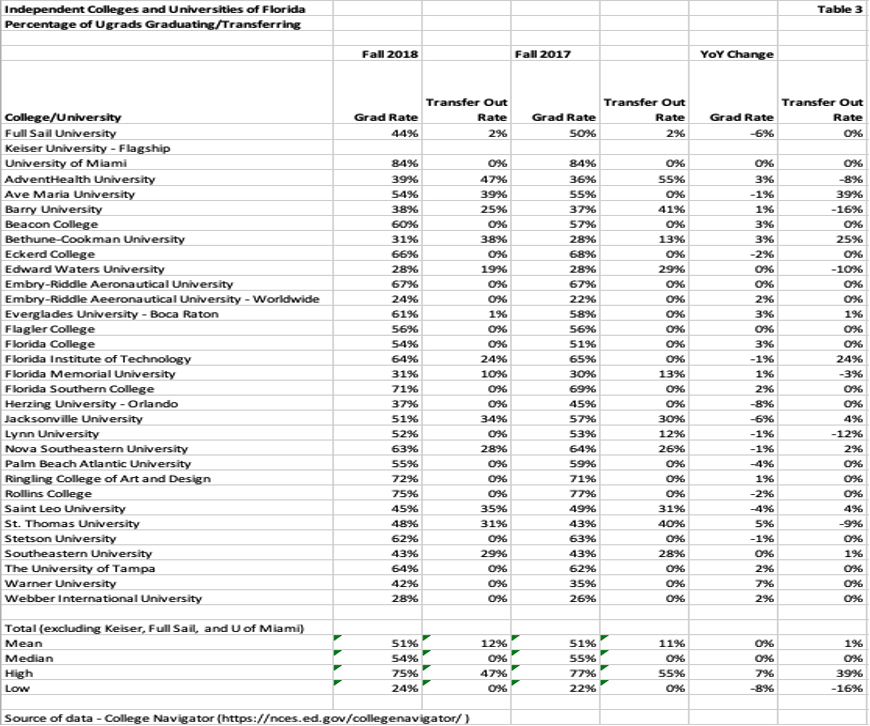
With low selectivity, the first thing that comes to mind is the percentage of students enrolling who graduate. Table 3 below illustrates the percentage of first-time, full-time undergraduates who graduated in six years, as well as the percentage of first-year students from that starting cohort who transferred out.
The group of 29 has a few colleges with what appear to be major swings, but the year-over-year change is not significant for the group. In the cases of a couple of colleges, the percentage is likely high because of enrollments below 1,000 students. It is important to note that the percentage of first-time, full-time students included in this calculation also varies widely by institution.
Because the most recent starting date was Fall 2018, any targeted improvements to increase the percentage of students graduating or reduce the percentage of students transferring out from that Fall 2017 cohort have not yet been disclosed. It is more than likely that the senior leadership teams at each of these institutions are aware of these trends and have processes in place to improve them. One institution, AdventHealth University, reduced its transfer-out rate by 8 percent, but it remains the highest in the group at 47 percent.
Graduate Student Enrollment and Tuition Revenues
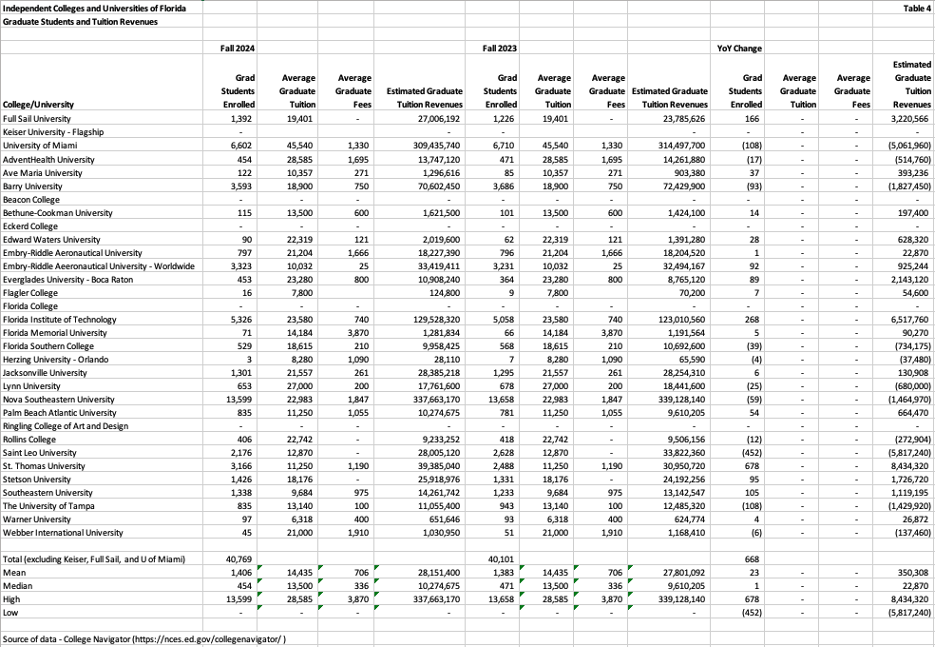
One important point to note is that most ICUF institutions have graduate student enrollments that generate incremental tuition revenue for the institution. Table 4 illustrates the year-over-year impact of increases or decreases in graduate tuition revenues for each institution. Note that the year-over-year comparative impact for average tuition per student and average graduate fees per student are zero because the Department of Education has not updated College Navigator’s tuition since November 30, 2025. The net change for the table, as currently displayed, only accounts for changes in enrollment based on the most recently published tuition.
Increases in grad student enrollment positively impacted St. Thomas University (+8,434,320), Florida Institute of Technology (+6,517,760), Everglades University (+2,143,120), Stetson University (+1,726,720), and Southeastern University (+$1,119,195).
Decreases in grad student enrollment negatively impacted Saint Leo University (-5,817,240), Barry University (-1,827,450), Nova Southeastern University (-1,464,970), and the University of Tampa (-1,429,920). As mentioned earlier, four colleges have no graduate student enrollment at all, and six have fewer than 100 graduate students.
Tuition, Cost of Attendance, and Net Price
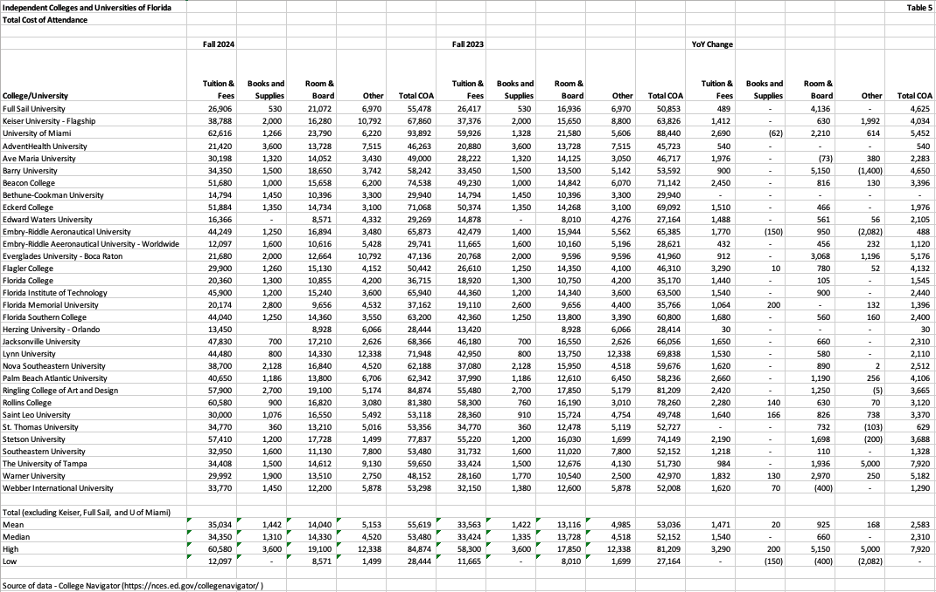
In Table 5, the major components of the published cost of attendance are listed for each institution for Fall 2024 and Fall 2023, the most recent published years in College Navigator. The year-over-year change is also calculated.
As usual, tuition is the largest component in the total cost of attendance. All institutions other than Bethune-Cookman University posted aggregate increases in Total Cost of Attendance, with tuition generally accounting for the largest single-dollar increase. Bethune-Cookman and St. Thomas University were the only institutions that held tuition flat. No institutions decreased tuition or total cost of attendance.
There are seven “groupings” of Total COA with the following institutions from highest to lowest:
- University of Miami – 90,000-95,000
- Ringling College of Art & Design and Rollins College – 80,000-85,000
- Beacon College, Eckerd College, Lynn University, and Stetson University – 70,000-78,000
- Keiser University, Embry Riddle University, Florida Institute of Technology, Florida Southern College, Jacksonville University, Nova Southeastern University, and Palm Beach Atlantic University – 62,000-68,000
- Full Sail University, Barry University, Flagler College, Saint Leo University, St. Thomas University, Southeastern University, the University of Tampa, and Webber International University – 50,500-59,500
- AdventHealth University, Ave Maria University, Everglades University, and Warner University – 45,000-49,000
- Bethune-Cookman University, Edward Waters University, Embry-Riddle Worldwide, Florida College, Florida Memorial University, and Herzing University-28,500-37,200
Without a detailed analysis of admissions and marketing materials, as well as a demographic analysis of enrolling students, it is difficult to explain the differences in Total COA other than that they are likely based on “positioning” each institution to its targeted demographic group. There are more groupings (seven) among Florida private colleges than there were among Virginia (six) and Maryland (five) private colleges. The low end of the Florida groupings is approximately $5,000 less than the low end of the Virginia groupings and about 10,000-12,000 less than the low end of the Maryland groupings.
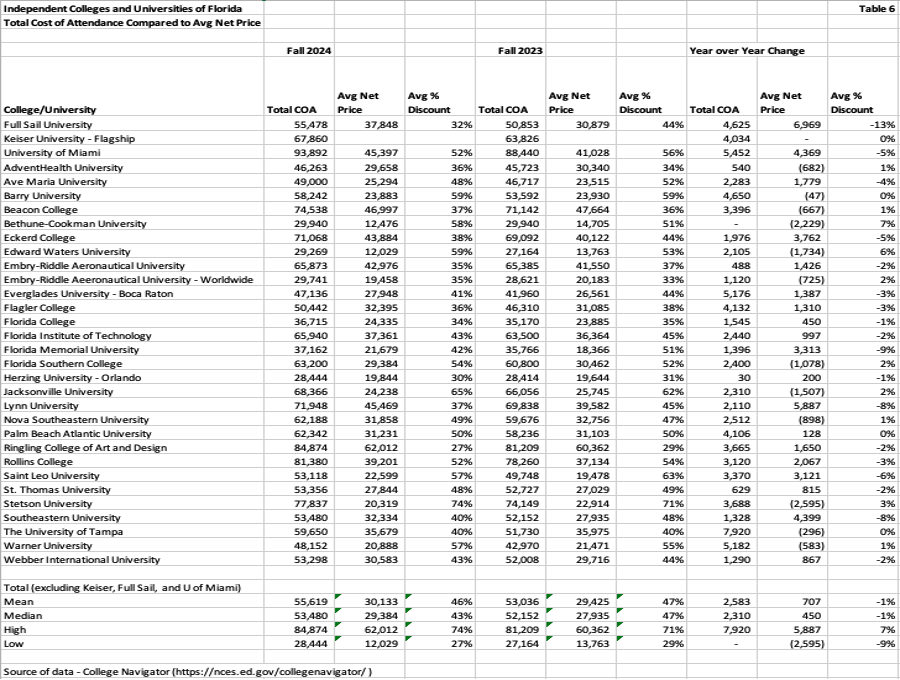
The published cost of attendance rarely matches the net price. Table 6 compares the total cost of attendance to the overall average net price and the average discount percentage for the last two years, along with the year-over-year change. Note that the average discount percentage is calculated as a percentage of the Total COA, not just tuition.
The median average net price for the group is $30,133 (this includes room and board and fees). The median average percentage discount for the group is 46 percent. The mean Total COA for the group increased $2,583, while the mean average net price for the group increased by $707. This implies that while the average “list prices” included in Total COA increased, the average discount decreased less than the average list price. An increase in average net price indicates that an institution is receiving more cash per student. Only 12 of the 29 institutions had negative changes in average net price.
The average net price ranged from a low of $12,029 (Edward Waters University) to a high of $62,012 (Ringling College of Art & Design). Most of the net prices hovered around the median of $29,384, with two others in addition to Edward Waters, in the under-$20,000 group. Overall, the average net price for Florida private colleges is approximately $3,000 higher than that of Maryland private colleges. With less enrollment pressure, maintaining higher net prices than a state with a higher Total Cost of Attendance is impressive.
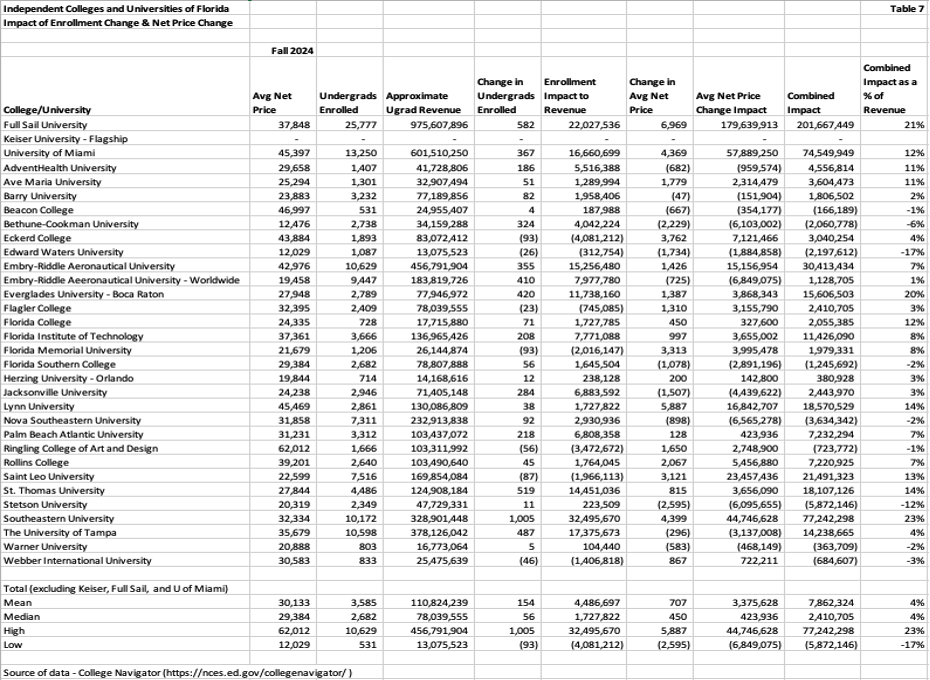
When undergraduate enrollments are increasing, a negative change in average net price may be okay. Table 7 below calculates the impact of enrollment changes and changes in average net price for each of the institutions in this group. Excluding the three institutions previously mentioned, the overall increase in undergrads enrolled of 4,459 improved the group of 29’s revenue by $130,114,205. The average increase in average net price of $707, due to a decrease in the average discount rate, positively impacted the group by $97,893,202. Compared to the other states reviewed, being a private college in Florida is, on average, much better than it is in Maryland and Virginia.
Reviewing individual schools, the results vary widely. Full Sail and the University of Miami, two of the three excluded institutions, increased their aggregate revenues by $276 million driven by higher average net prices.
Stetson University, with the highest decline in the group of 29, saw its average net price dip by $2,595 and was negatively impacted by a $6,095,655 decline in undergraduate revenues due to the decline in net price. Stetson increased its undergraduate enrollment, but that increase only provided $233,509 to offset the net price decline.
Eckerd College experienced the largest enrollment decline (-93) among the 29, but an increase in average net price of $3,762 raised overall revenue by $1.4 million, for a net increase of $3 million.
The largest increase in undergraduate revenues among the 29 colleges and universities is at Southeastern University. Southeastern increased its undergraduate enrollments by 1,005 and its net price by $4,399. The combination of those two positive changes resulted in a combined increase in undergraduate revenues of $77,242,298 (note: 32 percent of Southeastern’s undergrads attend 100 percent online, and 63 percent of its graduate students are online. Not all of the revenues in the COA estimate will go to the university if those increased enrollments are online enrollments).
Undergraduate enrollment at most of these private colleges and universities is campus-based, so adjusting expenses to offset declines in net revenues is not easy. Given that the enrollment and tuition data are two years old, only the institutions know how well they have managed amid an ongoing demographic cliff affecting enrollment and a very competitive environment affecting the average tuition discount rate.
A Few More Thoughts
Most colleges must be resourceful these days to survive, let alone thrive. You don’t need an MBA to realize that small, declining enrollments combined with higher tuition discount rates that lead to lower average net prices are a disastrous combination.
Florida is the first state in my year-over-year analysis to experience increases in both overall undergraduate enrollment and average net price. While it’s been widely discussed that a trend in high school graduates in the Mid-Atlantic and elsewhere is to attend southern flagship universities, nothing has been discussed about private colleges and universities in the South. While the majority of the 29 experienced a combined increase in net revenues, eight appear to have incurred declines in net revenues.
It’s important to remember that the average net price differs from the average net price by income quintile. Usually, though not always, the highest-income quintile has an average net price that is higher than the overall average net price. Depending on how much merit aid an institution awards to attract higher-income students, the discount for the highest bracket may exceed the overall average. It’s also possible that, with the recent changes to the ParentPLUS loan program, some of these institutions with lower endowments may experience declines in lower-income students because they cannot cover the gap in funding with the new program caps.
One point Daniel Greenstein made in his original analysis was that by the time acceptance rates reach 75 percent, nine out of ten institutions are at high financial risk. The admissions data for these institutions is two years old. Only 12 of 29 ICUF institutions had acceptance rates around 75 percent or higher. However, seven more have acceptance rates between 65 percent and 74 percent. The demographic cliff is not projected to impact Florida. However, given the widespread use of tuition discounting to attract students, most of these non-selective schools will have to work hard to maintain aggregate net revenues, let alone increase them at a high enough rate to cover rising expenses. This year’s outcome with an overall increase in the average net price was impressive.
Most of the colleges in this group have enrolled graduate students to increase revenues. Almost all have added business programs to their traditional liberal arts programs to attract new students. Tuition resets, in which the college deliberately cuts its tuition across the board (and the size of its merit aid awards), are increasing, according to a recent Wall Street Journal article. Some private colleges are offering in-state students an “in-state” rate to be more price-competitive. I saw no evidence of a recent tuition reset among these institutions, but there is a wide range in the Total Cost of Attendance bands, with a low of $28-29,000 (four institutions) and a high of $95,000 (University of Miami).
Small college presidents facing enrollment and tuition-discounting issues have a daunting challenge. If they raise their price, they risk decreasing their yield. If they cut prices, they erode their margin. Highly selective institutions like the University of Miami don’t have those risks. Online universities able to scale and offer a low cost of attendance, like Southeastern, Embry-Riddle Worldwide, and Nova Southeastern, don’t have those risks either.
In the aggregate, Florida’s private colleges did not experience enrollment declines. College Navigator reports the percentage of in-state versus out-of-state students for each institution, but I did not review that statistic. Given that Florida is currently not experiencing enrollment declines, it may be interesting to compare the outcomes for these private colleges and universities with Florida’s public colleges and universities. I’ll save that for a future project.