You would have to be a hermit, living a life removed from all forms of media and conversations with people, to be unaware of the multiple crises endangering institutions of higher education today and in the future. The intro to Deloitte’s most recent trends report does not pull punches about the current state of play.
“America’s higher education sector is poised for reinvention as declining enrollment, university funding cuts, advancing AI, and evolving regulations reshape the college landscape.”
The good news, according to Deloitte’s Higher Ed experts, is that “the core value of higher education has never been more apparent.” That might come as news to the majority of Americans who have “little or no confidence” in higher education, according to Gallup. The era of AI is the basis for Deloitte’s confidence. Their team believes that “institutions can play a critical role in preparing the next generation with the skills needed for a rapidly changing world.”
The fundamentally human skills of communication, judgement, and teamwork are core to a college’s mission, particularly those with a liberal arts emphasis. I agree that higher ed can develop these skills. I also believe that higher ed must rebuild the American public’s confidence to maintain its current enrollment levels.
To build a sustainable future, Deloitte believes that college leaders must reconcile two realities: (1) students seek degrees that lead to meaningful employment and (2) employers need graduates who have immediate skills and the ability to adapt as work changes thanks to ongoing developments and implementations of AI.
College leaders will have to redefine the promise of college as an engine of economic mobility and a powerhouse of critical innovation. Deloitte believes that college leaders can do that if they:
- Leverage unprecedented uncertainty as a means to finally impact the cost structure of the modern university in ways that bolster teaching and research.
- Shift the conversation from the “cost of college” to the “return on a credential” to reassert the value of degrees.
- Rethink the funding models and operational efficiency of scientific research at a time of pullback of federal support.
- Consider a future with fewer but stronger US colleges as more institutions choose to merge or form strategic partnerships.
- Proactively seek new ways to adapt to the changing global higher education landscape.
Deloitte identifies five trends that college presidents and their boards should prepare for to redefine the promise of college. Each of these trends is summarized in a separate section to mirror the Deloitte report’s outline.
Trend 1: Erosion of the Revenue Model
Citing the federal reductions in sponsored research, reduced international and graduate enrollments, caps on student loans, new taxes, and the arrival of the demographic cliff, Deloitte notes that many colleges were forced to change their business models in 2025. That should be no surprise, as they point out that more than half of the private universities rated by S&P Global in 2024 generated operating deficits.
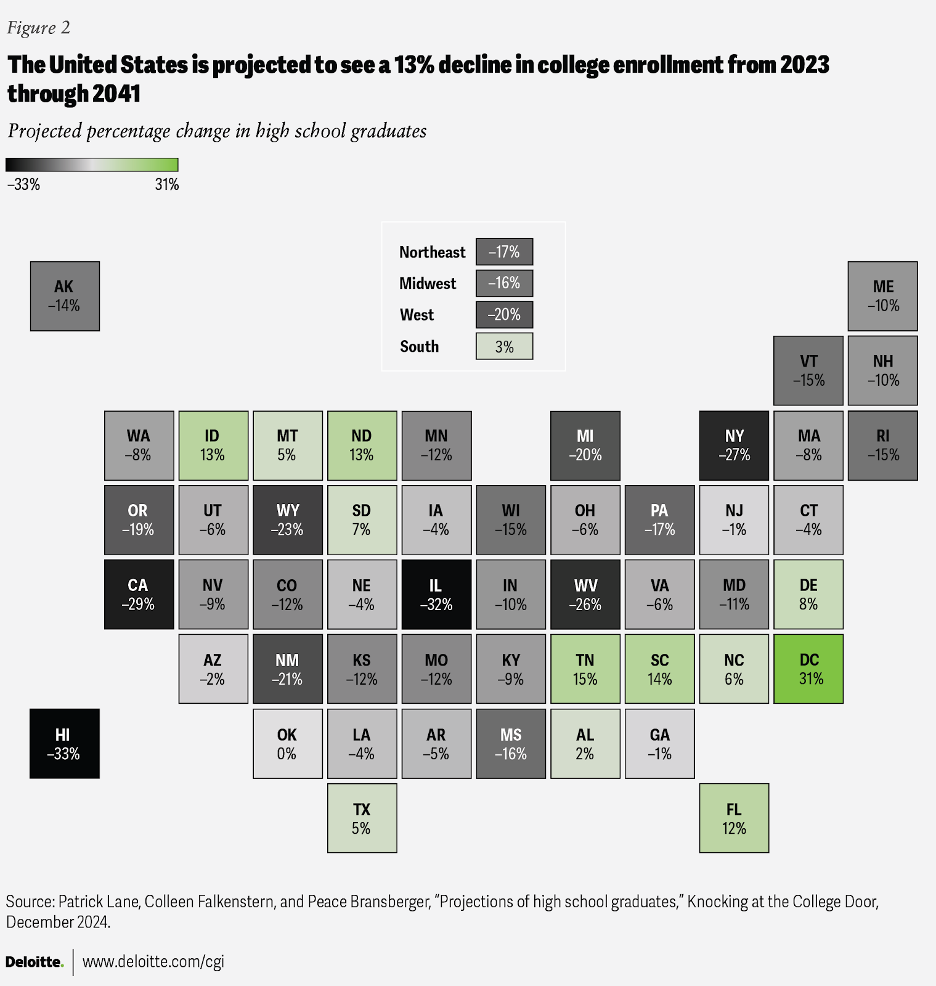
For those familiar with the demographic cliff, it does not impact all states equally. Figure 2 from the trends report provides a sharper focus on those differences with the declines (or growth in a few cases) by state. The South is the only region of the US expected to see growth in college enrollment over the next 18 years.
During recessions or other economic downturns, state legislatures have responded to declines in tax revenues by cutting higher education funding. Deloitte’s experts note that at least 15 states proposed reductions to public university budgets in 2025. Some of those reductions have led college and university leaders to axe degree programs with low enrollments.
Trend 2: Shift the Conversation from “The Cost of College” to “The Value of a Credential”
Evidence of declining confidence in higher education has led leaders to seek ways to “better demonstrate the value of their degrees and credentials.” That requires having conversations about jobs and the wages earned by graduates. The Obama administration recognized the importance of wages earned by graduates and created the College Scorecard, even though the Scorecard only reports earnings for students who borrowed federal loans or received Pell grants.
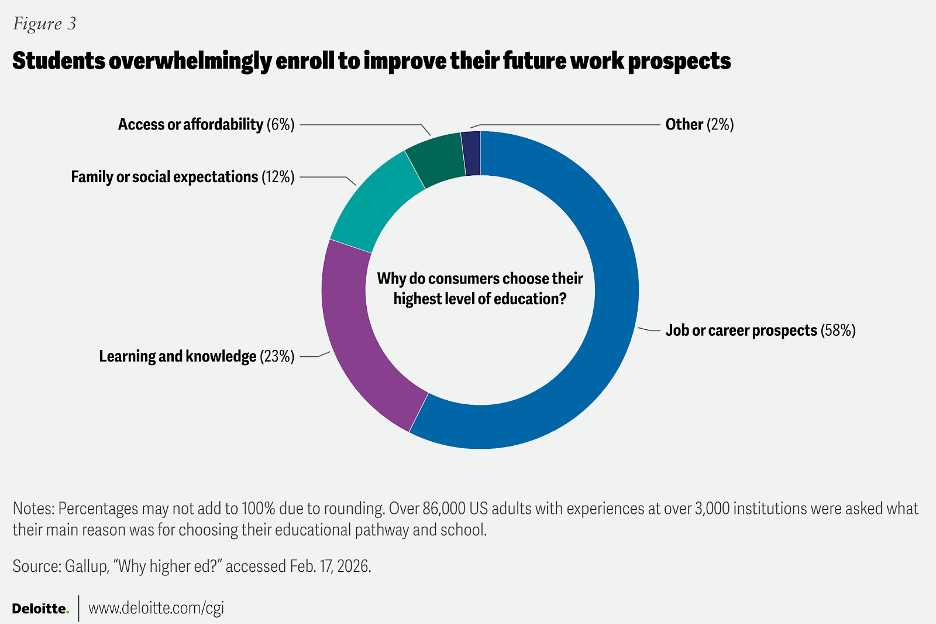
The number one reason students cite for going to college is to improve job and career outcomes. In Figure 3, Deloitte presents the outcomes of a recent Gallup poll. Job or career prospects outweigh the next closest category, learning and knowledge, by nearly 3x. For a lifelong learner like me, that’s a little scary but also understandable.
Deloitte cites several states (and specifically mentions Texas) that are taking the initiative to focus on outcomes for students attending public colleges and universities. A new accrediting agency, the Postsecondary Commission, initiated by several state public university systems, is focusing on the lifetime earnings and economic mobility of graduates of its member institutions.
While colleges are offering more credentials than ever (1.1 million in the U.S., per Credential Engine), most non-degree credentials do not lead to higher paychecks. Deloitte cites a Burning Glass Institute report indicating that only 12 percent of non-degree credentials lead to significant earnings gains. Despite those findings, Congress has approved the Workforce Pell program, allowing Pell grants to fund credential programs as short as eight weeks.
The report’s authors write that one of the key challenges “is figuring out how to accurately measure economic return on degrees and credentials–and deciding what to measure.” One of the classic conundrums mentioned is the degree programs in fields with low pay that carry great value, such as early childhood education, and whether the solution is to lower prices or increase pay for those jobs. My personal feeling is that higher-cost colleges should not offer these degrees at all, and lower-cost institutions should always advocate for higher pay for their graduates.
Another challenge mentioned is that wage data in many states is not available for researchers to measure. And, as I mentioned earlier, because Congress has banned the creation of a student unified dataset, the College Scorecard does not collect wage information on students who don’t borrow, a group that exceeds 50 percent of college graduates in some states.
Deloitte’s experts recommend that colleges review their programs more frequently and communicate in “real-time” between employers and faculty to align learning outcomes with job expectations. College leaders at liberal arts colleges should communicate the human skills those degrees impart and how they align with jobs that require AI use.
Trend 3: A Reset for Sponsored Research
Recent changes in traditional contract arrangements between the federal government and research universities have created short- and potentially long-term shifts in the funding model universities have become accustomed to.
The report notes that unexpected withdrawals of previously approved funds have forced colleges to quickly adapt to a changing fiscal outlook. Colleges have cut research budgets, reduced staff, frozen hiring, and cut admissions to PhD programs to adjust expenses to match the reduction in revenues.
While some colleges have found philanthropists to fund research, Deloitte maintains that philanthropists cannot make up for the reduction in federal funding. The federal government currently provides $50 billion in annual research funding compared to philanthropy’s $5 billion in annual funding (as of 2021, the most recent year reported).
Universities may find that corporate sponsors are only willing to fund applied research instead of basic or theoretical science. Deloitte warns that this could impact US innovation and future economic growth.
Colleges and universities are trying to win back federal grants by promising to streamline administrative costs, which the Trump administration tried to cap administrative costs for research grants at 15 percent. While judges have blocked many of those caps, Deloitte notes that colleges must provide more transparent explanations of the need to cover indirect costs supporting researchers.
Trend 4: More Colleges Explore Mergers and Partnerships to Preserve Core Missions
Deloitte writes that while mergers have held steady, there are more signs that college leaders are open to the possibility. An Inside Higher Education survey of senior leaders indicated that 19 percent have had internal conversations about merging with another institution. Another 19 percent said it is somewhat or very likely that their institution will merge or be acquired in the next five years.
Figure 4 from the report highlights the number of college closures and mergers in the US over the past decade. I suspect that the majority are closures and not mergers.
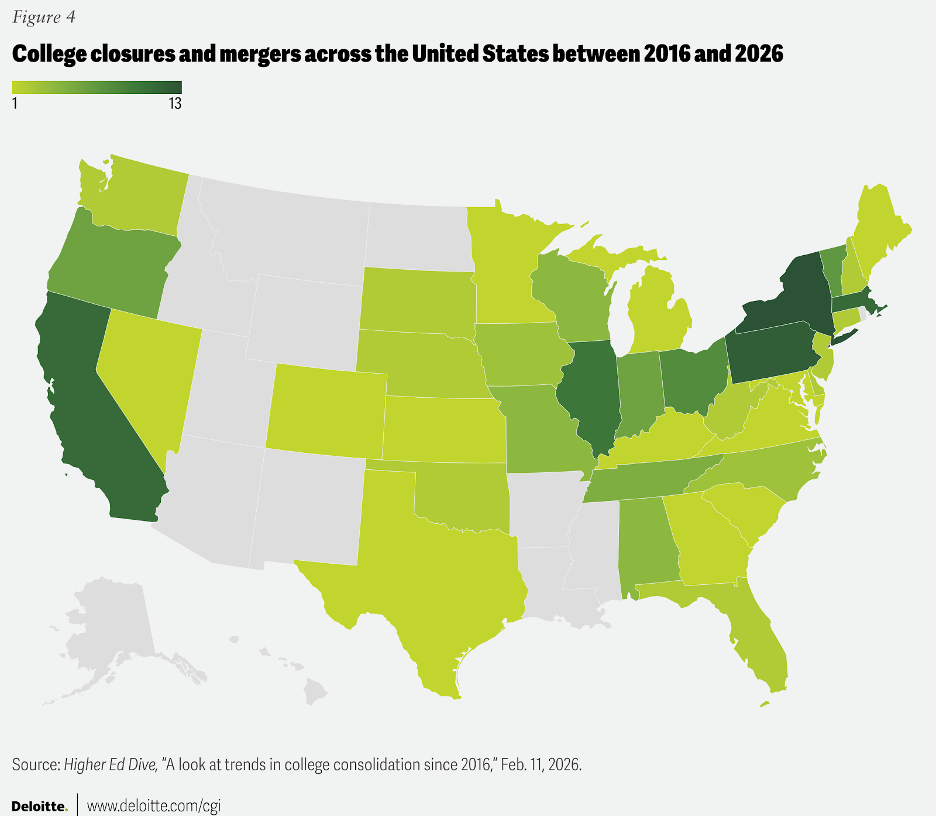
Deloitte’s experts write that a key driver of mergers and acquisitions is supply and demand. With projected enrollment declining by 13 percent over the next 15 years due to demographics, mergers/acquisitions may not see the level of activity seen in outright closures. Institutions that wait too long to pursue a merger may not be an attractive target.
Pulling off a college merger is a complex process. Deloitte’s experts advise developing clear goals and securing support from boards and public officials. Institutions should consider alignment with mission, culture, and complementary academic offerings. Merged entities that don’t act as a single entity often “destroy more value than they create.”
Trend 5: A changing global higher education landscape requires strategic shifts by U.S. universities
International students comprise about six percent of enrollment at U.S. colleges (approximately 1.2 million students). At many institutions, international students pay full tuition rates, a welcome financial relief compared to the discounted rates that many U.S. students pay.
New restrictions and increased scrutiny of student visas led to a decline in international student enrollments. In the Fall of 2025, international enrollments fell 17 percent, costing the U.S. economy $1.1 billion.
Visas are not the only headwind. According to Deloitte, a slowing global economy and increased competition from other countries have contributed to a decline in international student numbers.
The decline in enrollments did not impact all universities equally. Per the report, the 200 universities with the highest foreign enrollments have more than 30 percent of their students from abroad. Deloitte further notes that 47 percent of graduate students and 58 percent of postdocs in STEM fields are international.
The U.S.’s decline in international student enrollments has been offset by increases in international enrollments at institutions in other countries. Specifically, increased enrollments in Asian and European institutions were noted. Several institutions have openly courted Harvard graduate students to transfer.
A Call to Action
Deloitte concludes its report with a call to action, stating that the promise of higher education has never been more essential, nor more contested. Bold action and principled leadership are required.
Leaders have an opportunity to reshape their institutions as agile centers of learning and innovation. They can use uncertainty as a catalyst to refresh structures and partnerships and demonstrate the value of higher education credentials.
A Few Additional Thoughts
The trends and issues related to research funding and international students affect a substantial minority of U.S. colleges and universities, and likely many of Deloitte’s U.S. university clients. That doesn’t diminish the relevance of their recommendations. However, leaders and boards of colleges that do not receive federal research grants or recruit substantial numbers of international students should consider these recommendations.
The commentary related to Trend 2, shifting the conversation, is important and should be a focus for every college struggling to meet its enrollment goals. Colleges that can provide internships for students throughout their undergraduate years that lead to relevant job offers by graduation will flourish during the age of declining enrollments.
Liberal arts colleges will win when they effectively communicate the focus of their programs, ensuring that graduates develop critical thinking and other skills important to employers in the AI era. Deloitte’s recommendations that leaders should coordinate “real-time” communications between employers and faculty are spot-on. Business schools have done this for years. There’s no reason that liberal arts programs cannot model that behavior.
I have written about the enrollment challenges that many private colleges and universities are facing. Leaders and boards may argue that their survival requires thinking about their shorter-term survival rather than developing and implementing some of these recommendations.
That may be true for a few institutions. But for those with a financial runway of 18-24 months or more, I suggest that discussing and implementing changes to address the challenges and recommendations under Trend 2 is vital for the survival of many small private colleges and smaller public institutions.
Change is hard, but it’s not impossible. Colleges facing challenges can succeed if they change to meet them head-on. It’s time to remove barriers to discussing education innovations and to meeting employers’ needs through relevant programs. And lest no one forgets, measuring and improving the learning and employment outcomes of all graduates is more vital than ever.