When my twin daughters were recruited by colleges, they were advised to apply to the business school because it was harder to transfer into the business school once they were enrolled at their respective colleges than it was to apply to it in high school.
As D1 athletes, my daughters were required to meet weekly with their academic advisors.
The process of selecting a major evolved for one daughter. She majored in Information Systems Management because she liked the courses, and a few of her older teammates had majored in it. She minored in International Studies because she had enjoyed her Mandarin classes in high school and continued taking Mandarin courses in college. International Studies required a foreign language.
At the beginning of her sophomore year, my other daughter informed me that she wanted to transfer out of the School of Business and major in psychology. I asked her whether she knew that making that decision would prevent her from changing her major again, since transferring back to the School of Business would be impossible. She knew that and wanted to make the change because psychology was more interesting to her. After realizing she was set on a psychology degree, I advised her to consider earning a B.S. rather than a B.A., as many graduate programs in psychology require a B.S. She followed my advice and earned a B.S. in psychology.
As I observed (and semi-participated) in the process of selecting (and changing) majors for my daughters, I reflected on my own experience and the experiences of my three siblings. All of us changed our minds about our majors. Fortunately, I was able to stay at Duke. My siblings transferred to other colleges to major in finance, nursing, and marketing; all programs that were unavailable at their original colleges.
When I read Steven Mintz’s Substack article, “We’ve Made Choosing a Major Too Hard,” the text triggered memories of my experiences and those of my siblings and daughters. I thought it was worth further thought and discussion.
The Question We Ask Students Too Late
The anxiety surrounding college majors reflects a structural issue in how the American education system approaches the transition from high school to college.
Students are frequently asked to identify intended majors during the college admissions process. The Common App makes it look easy, with numerous options to select, including “Undeclared.” By the time high school graduates arrive on campus, some of them may already feel committed to academic pathways they only partially understand, often before they have had meaningful exposure to careers or professional environments.
This creates a strange sequence of decisions. Students first choose colleges. Then they choose majors. Only afterward do many begin seriously exploring careers.
Logically, the order should be reversed. Students should begin by exploring careers and areas of interest, then identify academic fields that align with those interests, and only then select colleges that support those goals.
When the sequence is reversed, students understandably feel pressure to choose the “right” major before they can discover what truly interests them.
Why Choosing a Major Has Become So Difficult
Several trends have combined to make selecting a college major more complicated than it once was. I’ve identified four main reasons:
- Students face an overwhelming number of choices. Credential Engine touts 1.85 million credentials offered in the U.S., many of them at universities. Dozens of colleges offer hundreds of majors and concentrations, many with specialized titles that may not clearly correspond to careers. Mintz writes that his university offers 115 program majors. For a student just beginning to explore academic interests, this abundance of options can feel paralyzing.
- We have attached too much meaning to the choice of a major. Students often believe their major defines who they are and permanently determines their career. Steven Mintz writes that “we treat declaring a major like taking a vow…the message is clear: choose wrong now and you may never recover.”
- The financial stakes of higher education have increased dramatically. When tuition was lower, experimentation carried fewer consequences. Today, students worry that changing majors could delay graduation and increase the cost of their already expensive education.
- Some programs require early commitment. Competitive majors such as engineering, nursing, business, and computer science often require sequential coursework beginning in the first year.
Aggregated, these pressures make the choice of a major feel far more consequential than it should. Mintz writes that “part of the problem is that we’ve collapsed three different questions into one: What do I enjoy? What am I good at? How will I earn a living?” He adds that answering those questions takes time and requires exposure, feedback, and experience. That’s one of the reasons that I believe the process of identifying your field of study should start earlier, in high school.
The Reality: Many Students Change Majors
One reason students worry so much about choosing the “right” major is the belief that most students follow a straight academic path from the moment they arrive on campus. In reality, that assumption is incorrect.
Research suggests that roughly one-third of college students change majors at least once during their undergraduate years. Exploration, after all, is famously a common aspect of the college experience.
Certain majors experience particularly high switching rates. Highly structured STEM programs, especially engineering, chemistry, and physics, often see significant numbers of students change majors. Students leaving those programs frequently migrate toward fields such as business, psychology, communications, or interdisciplinary studies.
These changes reinforce an important point: Students often begin their real exploration of academic interests only after they arrive at college. That’s too late, in my opinion. The process of exploring one’s academic and career interests should begin in high school before a student applies to college.
Experience Makes a Difference
During my years as president of American Public University System (APUS), I observed a striking contrast between traditional college students and adult learners.
Most of our students at APUS were working adults, many in their late twenties or thirties, with several years of professional experience. Many were military personnel, others were mid-career professionals seeking advancement, and some were returning to complete degrees they had postponed earlier in life.
Unlike many traditional college students, these learners rarely struggled with choosing a major. Their work experience had already helped them develop a clearer sense of their interests and career goals.
Traditional students typically arrive on campus between the ages of 18 and 22 with limited exposure to professional environments. Adult learners, by contrast, have already spent years in workplaces and have seen career paths up close.
The contrast highlights an important lesson: Experience clarifies educational choices.
If we want younger students to make more informed decisions about majors and careers, we should provide earlier exposure to professional environments through internships, job shadowing, and career advising during high school.
Advising Begins Too Late
Today, most structured advising about majors and careers begins after students arrive on campus. By that point, however, several critical decisions have already been made.
- Students have chosen which colleges to apply to.
- They have often indicated intended majors on applications.
- They may have selected colleges partly because of those intended majors.
Yet many of these decisions are made with limited exposure to actual careers.
High school counseling offices do an excellent job helping students navigate the admissions process, but career exploration often receives far less attention.
The Case for Thinking in Terms of Fields of Study
An interesting perspective on this issue appears in the book Hacking College: Why the Major Doesn’t Matter—and What Really Does by Ned Laff and Scott Carlson. The authors suggest that students should think less about selecting a single major and more about developing a “field of study.”
Under this approach:
Field of Study = Major + Electives + Internships + Research + Career Exploration
The major becomes one component of a broader educational strategy.
This approach also encourages students to use the “blank spaces” in their curriculum, namely electives and general education courses, to deepen their interests and connect academic learning to real-world problems.
High school is the ideal time to introduce structured career advising. Students could benefit from:
- Industry panels
- Career exploration programs
- Internships and experiential learning
These experiences would help students connect academic interests with potential career paths. Choosing a college major should not feel like a high-stakes gamble. If high schools incorporated structured career exploration and advising, students would arrive at college better prepared to choose academic pathways that align with their interests.
I’m not naïve about the budgetary constraints many high schools face, for those who think my suggestions are aspirational. To increase the return on investment for public and private schools, collaborations and partnerships between colleges and high schools should become the norm rather than the exception.
Colleges that communicate with local and regional high schools about the career pathways that align with the programs they offer are more likely to be viewed as attractive options by school counselors, students, and parents as they navigate the process of selecting colleges that match students’ aspirations.
The AI Economy Makes Career Exploration Even More Important
Artificial intelligence and automation are reshaping the labor market. Software systems increasingly handle many routine tasks. As a result, employers are placing greater emphasis on human capabilities such as problem-solving, communication, creativity, and interdisciplinary thinking.
These are not skills tied to a single academic major. I recently wrote that liberal arts degrees provide a valuable framework of human capabilities, such as problem-solving and critical thinking.
This reality reinforces the importance of thinking in terms of fields of study rather than isolated majors. Ned Laff and Scott Carlson devote a chapter in Hacking College to the concept of solving the “Wicked Problem,” the motivating problem that a student would like to solve as his/her life’s mission. While Laff and Carlson outline their four-step field of study process as a college framework, there is no reason that it cannot and should not begin in high school. It’s logical to assume that students with a better understanding of the relationships between their hidden intellectualism, their undergraduate plans, and the job market will find relevant career opportunities faster than those who start down a career or field of study pathway much later.
A Few Final Thoughts
I asked ChatGPT to build an infographic that I could use to illustrate the differences between the program major decision as it currently exists and as it could exist. I’ve appended that figure below.
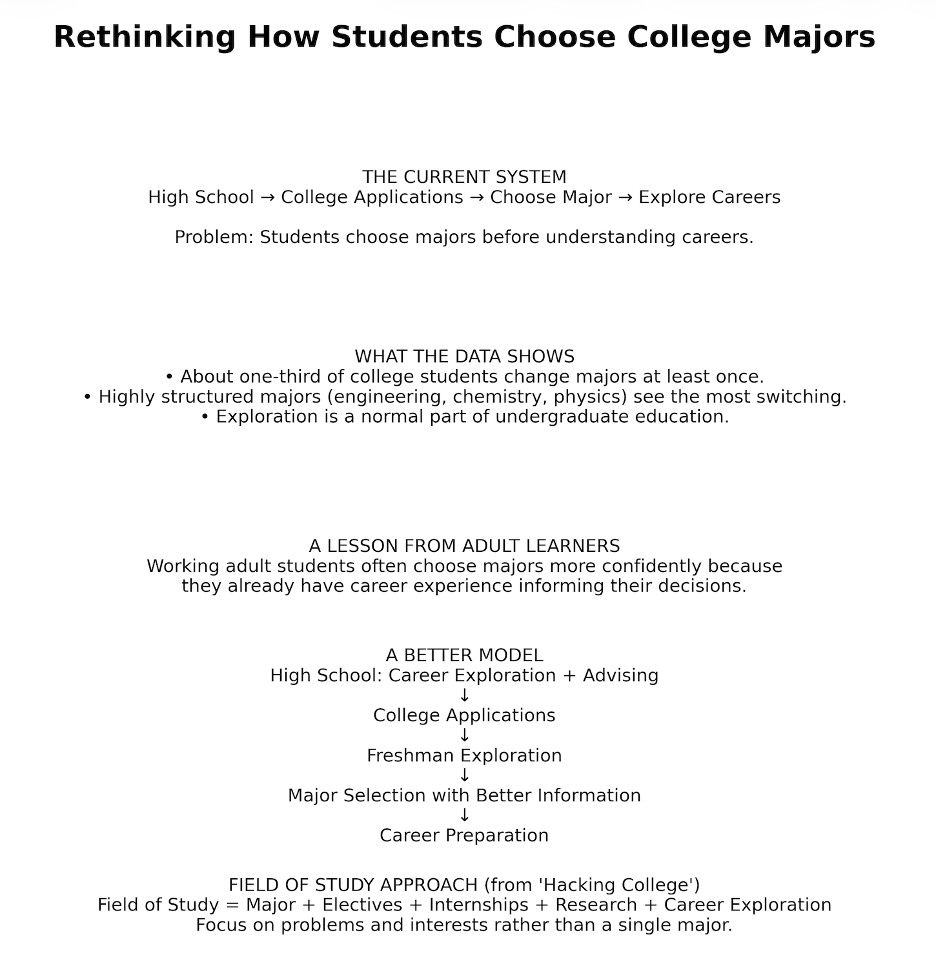
I chose not to edit the infographic. While I might have preferred a figure with more color and objects other than arrows, the information is directionally correct.
What the infographic does not show is the proposed tighter collaboration and partnerships between colleges and high schools. In an era when the Demographic cliff threatens the continuity of many higher learning institutions and AI is reshaping the job market for college graduates, communicating program pathways to careers can only benefit colleges that partner with high schools to broaden that understanding.
Postscript
After the article was posted for a few hours, I receive the following email from a former colleague, Mustafa Abdelwahid. His perspective on how selecting majors works in the Middle East and other developing countries is interesting and insightful. His points made that younger students (11th grade) may make poor choices is valid. The overarching theme of my article and his response is that better information (advising and experience) is the best way to ensure that students make better choices.
Dear Dr. Wally:
The anxiety surrounding the choice of a university major reflects a structural issue in how many educational systems manage the transition from secondary education to higher education. In the United States, students are frequently asked to indicate an intended major during the university admissions process. However, in much of the Middle East and the developing world, the process begins even earlier. Students are often required to make preliminary academic decisions during high school itself, typically around the eleventh grade, when they are asked to select between distinct educational “pathways” that will shape their future university options.
At this stage, students are commonly directed into broad academic tracks that determine the subjects they will study during the final years of secondary school. The most common model divides students into several principal pathways. One of these is the science–biology track, which is generally intended for students planning to pursue medicine, pharmacy, dentistry, nursing, or other health-related professions. Another pathway is the science–mathematics track, designed primarily for those who anticipate studying engineering, computer science, architecture, or other mathematically intensive disciplines. A third pathway typically encompasses arts, humanities, and social sciences, while in some systems, business and administrative studies form a separate stream or are incorporated within the humanities pathway.
While this structure aims to provide academic focus and preparation for specialized university programs, it also requires students to make consequential decisions at a very early stage of intellectual development. At sixteen or seventeen years of age, many students have had limited exposure to the professional realities associated with the careers these pathways are meant to support. Yet the choice they make in the eleventh grade can significantly influence the university programs available to them later. A student who selects the science–biology track may find it difficult to transition into engineering programs that require advanced mathematics preparation, while a student in the humanities pathway may face barriers if they later develop an interest in scientific or technical fields.
The early timing of these decisions becomes even more consequential when family and social expectations are taken into account. In many societies across the Middle East, Africa, and parts of Asia, academic choices are rarely made in isolation. Parents, relatives, and community expectations often play a significant role in guiding students toward particular pathways. Medicine and engineering, for example, continue to be widely perceived as prestigious and economically secure professions. As a result, students may select the science tracks not necessarily because they possess a strong personal interest in those disciplines, but because of the social status associated with those careers.
Consequently, the process of selecting an academic field is effectively divided into two stages. The first stage occurs in high school, when students choose the general pathway that will structure their academic preparation. The second stage occurs later during university admissions, when they apply to specific faculties or programs aligned with that earlier pathway. By the time students formally apply to universities, many of the most consequential academic choices have already been made.
This structure contrasts with educational systems in which students enter university without declaring a major and spend their first year or two exploring different disciplines before specializing. In systems where specialization begins during high school, the margin for intellectual exploration becomes significantly narrower. Students may feel locked into academic trajectories that they only partially understand, often before they have had meaningful exposure to the careers those trajectories are intended to support.
For this reason, the issue of choosing a major cannot be understood solely as a university-level challenge. In many parts of the world, it is fundamentally a secondary-school issue. The critical moment occurs not during the university application process, but earlier, when students are asked to select their academic pathways in the eleventh grade. At that stage, educational systems are effectively asking adolescents to make decisions that will shape their academic and professional futures long before they have had the opportunity to explore their intellectual interests in a systematic way.